The Examiner’s Direct Answer: Is There an Absolute Fail Limit?
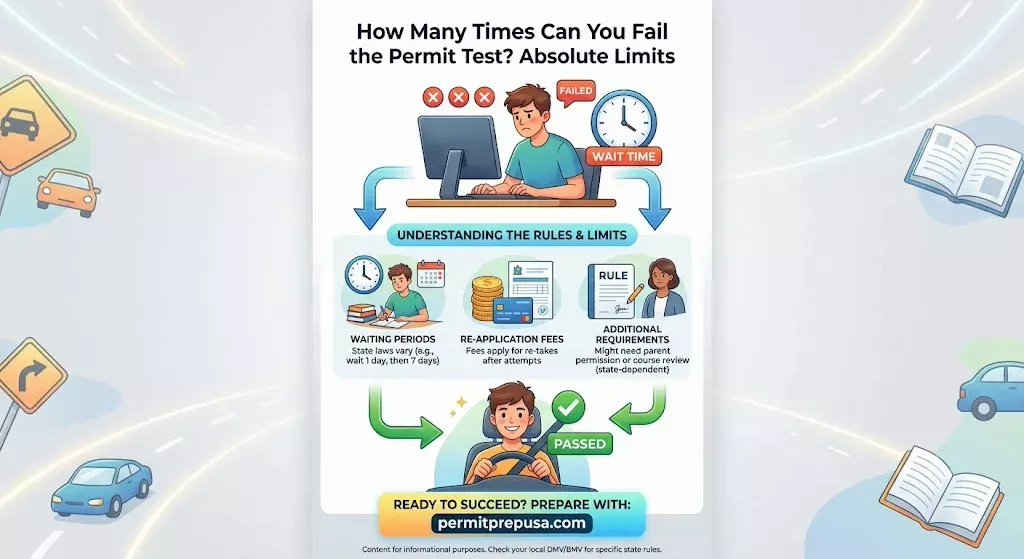
Quick-Answer Box: There is **no lifetime limit** on how many times you can fail the DMV permit test, but there is a strict **per-application limit**. In almost all states, your initial application fee grants you a maximum of **3 attempts** to pass the written exam. If you fail the test 3 times, the DMV legally voids your current application file. To try a 4th time, you must open a brand-new application, resubmit all identity documents, and pay the full application fee over again.
Every single week, I sit at my desk and watch the exact same nervous individuals walk into our lobby. Some of them are on their second attempt, some are on their third, and a few are trying for the fourth or fifth time. I can see the sheer exhaustion in their eyes as they ask me the ultimate high-stakes question: "Examiner, if I fail this terminal again today, am I banned from getting my license permanently?"
As a DMV examiner, let me immediately dispel the horror stories you hear online: the state is not going to permanently blacklist you or ban you from driving for life just because you struggle with a written knowledge evaluation. There is no ultimate lifetime cap on failures.
However, while the lifetime limit does not exist, the administrative and financial penalties for repeating failures are incredibly real. The Department of Motor Vehicles does not operate a free arcade; we run a highly regulated legal system. If you treat our testing kiosks like a guessing game, we will continuously cancel your files and make you pay to start over. Let’s look at the absolute mechanics of the 3-strike rule, evaluate how different states penalize chronic failures, and outline how to break the cycle of constant retests.
Deconstructing the 3-Strike Rule: The Lifetime vs. File Limit
To understand the scoring boundaries, you must understand how the DMV tracks your identity. When you step up to my counter and present your paperwork, we create an active electronic driver file. That file contains your unique tracking number, your verified home address, and your biometric data.
Your initial application fee is essentially a contract. It tells the state that we will process your data and give you a standard package of testing opportunities. Across the vast majority of U.S. jurisdictions, that package consists of exactly **three attempts** to clear the written kiosk.
If you fail the first time, your file remains active. If you fail the second time, your file remains active. But the exact split-second you log your third failure, the automated system executes a hard administrative reset. The file is closed and marked as "Expired due to consecutive failures."
This means your journey does not end, but your wallet takes a hit. To unlock a fourth attempt, you cannot just come back the next day. You must step all the way back to the start line. You must re-queue in our main documentation line, fill out a completely fresh application form, present your original birth certificates and residency proofs all over again—exactly as we detailed in our guide on what to bring to your DMV permit test appointment—and pay the maximum application fee a second time to receive three fresh attempts.
The Financial and Temporal Math of Chronic Failure
Let's look at the real-world compounding costs of failing the knowledge exam multiple times. Many applicants think a failure is just a minor annoyance, but the structural math shows it is a massive drain on your resources.
Every single failed attempt beyond your first try usually triggers an individual re-examination fee. For example, if you are testing in Florida, each retake at the terminal carries an administrative penalty fee. If you burn through all three attempts and have to purchase a brand-new application file, your financial investment doubles instantly.
Worse than the monetary cost is the "Time Tax." When you fail, you don't just lose points on a screen; you trigger mandatory cooling-off windows. We broke down these individual state restrictions in our foundational report explaining can you retake the DMV permit test if you fail. If you fail three consecutive times in a strict state like California, the mandatory weekly wait times combined with the gridlock of our booking portals means three failures can easily delay your driver's license timeline by a month or more.
How State Rules Shift Beyond the Third Failure
Once you cross the threshold of your third failure and enter the realm of your fourth, fifth, or sixth attempt, several state motor vehicle departments introduce aggressive interventions to ensure you aren't simply wasting public resources.
To help you see how the regulatory landscape shifts for repeat failures across major populations, I have organized the advanced retake parameters into a clean, mobile-optimized reference table tracking the rules beyond the initial three-strike limit.
| State Jurisdiction | Rules and Resets Beyond 3 Failures |
|---|---|
| California | Full Reset Required: The application is voided. You must repay the full fee and wait a mandatory 7 days between subsequent tries. |
| Texas | The 90-Day Clock: Your 3 attempts must happen within 90 days. If you fail 3 times or cross 90 days, you must pay the full fee to restart. |
| Florida | Continuous Fees: You can keep buying new attempts, but each file reset charges a fresh application fee plus a $10 retest penalty. |
| Nevada | Mandatory Remedial Wait: After the 3rd failure, the waiting interval frequently scales up, forcing longer study gaps before a 4th attempt is authorized. |
As an examiner, I have seen individuals buy three or four separate applications over a six-month period, failing nine or ten times in a row. It is an incredibly expensive and demoralizing way to realize that your study methods are completely broken.
Breaking the Failure Loop: An Examiner's Intervention
If you have already failed the test once or twice, you are officially in the danger zone. You cannot afford to keep using the same casual study habits. If you walk back into my testing room relying on the exact same strategy that failed you previously, the machine will lock you out again.
To break the failure loop permanently, you must execute three immediate tactical adjustments:
1. Stop Relying on the "Anxiety-Driven" Pace
When applicants fail their first attempt, they often rush their second attempt because they are terrified of the running mistake counter. This anxiety causes them to skip over vital modifier keywords. If you rush, you will miss questions simply because you didn't see a word like "NOT" or "EXCEPT." We highlighted this psychological trap extensively in our direct breakdown of the most common DMV permit test mistakes first-time drivers make.
2. Overhaul Your Baseline Knowledge Matrix
Failing multiple times proves that you are trying to use general intuition instead of technical memorization. Our database is programmed to extract exact numbers. You must know the precise blood alcohol concentration (BAC) thresholds, the exact distance restrictions for parking near crosswalks, and the strict legal guidelines for lane changes. If you do not know the exact metrics, you are simply gambling with your score margin. Read our examiner's guide on how hard is the DMV permit test to understand the true level of precision our terminals expect.
3. Enforce the "Double Pass" Simulation Rule
Never come back to my counter just because you managed to get a passing grade on a single online quiz. That is a false metric of readiness. You must implement a highly rigorous, closed-book best DMV practice test strategy at home. Do not schedule a retest appointment until you can open a randomized simulator and comfortably score a 95% or higher on five unique practice tests in a row.
You must build a massive knowledge cushion at home so that when the real-world pressure of our government facility hits you, your score stays safely above the state's baseline percentage. To review those localized benchmarks, reference our report on what score do you need to pass the DMV permit test.
The Final Word from Behind the Desk
There is no shame in failing the knowledge exam. Millions of exceptional drivers failed their written tests on the first or second try due to simple nerves or a lack of structured preparation. The DMV will always allow you to try again, provided you respect our processes and pay the required administrative fees.
But do not treat our terminals like a lottery. The manual is the direct source code for every single prompt on the monitor. Take a deep breath, serve your mandatory waiting periods, study the exact metrics, and you will easily break the failure cycle and claim your learner's permit.
