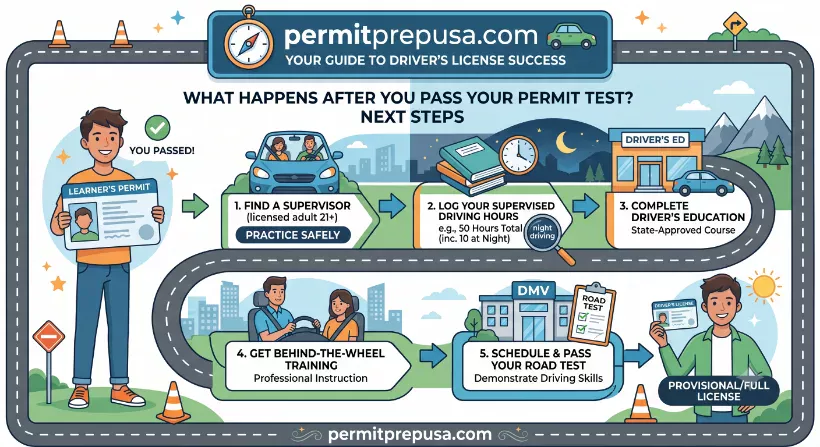
The Examiner’s Direct Congratulations: You Passed!
Quick-Answer Box: The exact moment you pass your DMV permit test, the testing terminal freezes and instructs you to return to the counter. The examiner will verify your score in the server, take your digital signature, and print a **temporary paper learner's permit** (valid for 30 to 90 days). Your permanent plastic permit card will arrive in the mail within **2 to 4 weeks**. Once you hold that paper, you are legally allowed to begin supervised driving practice, but you **cannot drive alone under any circumstances**.
It is one of my favorite moments behind the counter. An applicant walks away from the testing terminals, practically glowing with relief, and proudly slides their paperwork across my desk. They have successfully survived the kiosk, protected their score buffer, and proven they understand the baseline rules of the road.
But right after the initial high-fives and celebrations fade, a wave of confusion usually sets in. The teenager or adult will look at me blankly and ask: "Okay, Examiner... what exactly happens now? Can I drive myself home from the DMV today?"
As a DMV examiner, let me give you some straight facts: passing the written knowledge exam is a massive milestone, but it is not the final finish line. It is simply the gateway to the physical phase of your licensing journey. The state has verified your theoretical knowledge; now you must prove your practical execution. Let's deconstruct the immediate administrative steps at the counter, look at the transition to behind-the-wheel training, and examine the strict legal boundaries you must respect the second you walk out our doors.
Step 1: The Administrative Loop at the Counter
When the computer screen flashes green and informs you that you have cleared the required passing threshold, your first administrative duty is to return directly to my window. Do not leave the building. The data inside the terminal must be officially processed and attached to your permanent state file.
Here is the exact operational sequence we execute at the desk:
- Score Verification: I pull up your testing terminal record on my master screen to confirm the electronic lock-out script didn't flag any irregularities and that you achieved the required mark outlined in our guide on what score do you need to pass the DMV permit test.
- The Official Photograph: If we didn't take your photo before the test, you will step up to our blue screen. This image will follow you for years, so ensure your eyes are open and you follow our strict guidelines (no hats, no sunglasses).
- The Paper Printout: Because secure plastic cards must be manufactured at a centralized state facility, I cannot hand you a plastic permit on the spot. Instead, I will print a secure, thermal paper document known as a Temporary Instruction Permit.
This paper document is a fully legal, state-recognized driving credential. However, it usually features a strict expiration date of 30, 60, or 90 days. It is designed to bridge the gap while our main production facility stamps, encodes, and mails your official plastic card to the address verified from what to bring to your DMV permit test appointment. If your plastic card does not arrive within 4 weeks, you must contact our agency before the paper copy expires.
Step 2: The Supervised Practice Mandate (No Driving Alone)
The most critical legal reality you must understand the second I hand you your temporary permit is this: **You are strictly forbidden from operating a motor vehicle by yourself.**
I have had to suspend applications and issue heavy citations to teenagers who took their paper permit, walked out to the parking lot, and attempted to drive their friends home while their parents rode in a separate car. That is an immediate violation of your state's Graduated Driver Licensing (GDL) laws.
A learner's permit is exclusively a license to practice under strict, expert supervision. By statutory law, whenever you are behind the steering wheel, you must have a licensed driver sitting in the front passenger seat directly next to you. This person cannot be in the back seat, they cannot be asleep, and they cannot be under the influence of alcohol or prescription drugs.
The age requirement for this supervising passenger changes based on your location. In many states, they must be a parent, guardian, or a licensed driver who is at least 21 years old. In stricter jurisdictions, that supervisor must be 25 or older. Check your state's specific handbook layout to verify who can legally sit in your passenger seat.
Step 3: Activating the Logbook and Behind-the-Wheel Hours
Once you leave our office, your official training clock begins ticking. To graduate from your temporary permit to a full provisional or unrestricted license, you must log an intense volume of practical driving experience.
Most states mandate that minor applicants complete a minimum of **50 hours of supervised driving practice**. Furthermore, because driving variables change completely when the sun goes down, the state requires that at least **10 of those 50 hours** be completed strictly at night.
To help you track these requirements without fumbling through administrative forms, I have organized the standard progression into a mobile-friendly reference table tracking your operational milestones after passing the written kiosk.
| Training Stage | Required Milestones & Legal Actions |
|---|---|
| Stage 1: Professional Ingress (The First 6 Hours) |
Certified Instructor Validation: In states like California, your permit is not legally valid until an approved driving school instructor signs it during your initial lesson. |
| Stage 2: The Practice Log (Next 3 to 6 Months) |
Accumulate the Hours: Log 50 total hours (10 at night) with a parent or adult supervisor. Track maneuvers like parallel parking and highway mergers. |
| Stage 3: Road Test Booking (The Final Gateway) |
Schedule the Behind-the-Wheel Exam: Once the mandatory holding matrix clears, use our portal to book your practical road test evaluation. |
Do not attempt to falsify your practice logbook. When you return to my counter months from now to take your physical driving test, both you and your parent will be required to sign a legal affidavit under penalty of perjury certifying that every single one of those 50 hours was honestly completed.
The Mandatory Holding Periods: You Cannot Rush the Process
Many applicants believe that if they are exceptionally talented and complete all 50 hours of practice within the first two weeks, they can immediately come back and demand a road test. That is completely false.
The GDL framework relies heavily on mandatory holding windows to ensure your brain experiences different seasons and traffic conditions over an extended timeline. If you are under the age of 18, the vast majority of state motor vehicle departments legally require you to hold your learner's permit for a **minimum of 6 consecutive months** before you are even allowed to schedule a behind-the-wheel road test.
If you live in a highly restrictive jurisdiction like New York or New Jersey, that holding window scales up to a full 12 months. If you commit a moving violation, get into an at-fault accident, or violate curfew restrictions during this phase, the system will execute an automatic reset, forcing your holding clock back to zero. You can read our detailed breakdown on how hard is the DMV permit test to understand the level of strict compliance our agency maintains throughout every phase of the licensing funnel.
An Examiner’s Final Blueprint for Your Permit Phase
Now that you have bypassed the stress of the written database, do not let your technical knowledge rust. The exact legal definitions, right-of-way hierarchies, and pavement lane markings you studied so hard to pass at my terminal must now be executed in real-world environments.
If you treat your practice phase carelessly, you will quickly find out how devastating the administrative fallout can be when you face real-world citations—many of which we detailed in our guide tracking what happens if you fail the DMV permit test.
Keep your temporary paper permit protected in a clean folder, log your hours honestly, respect your adult supervisors, and treat every hour on the road like a serious legal responsibility. If you maintain that level of professional focus, your transition from a learner's permit to a full, unrestricted driver's license will be an absolute success.
