The Examiner’s Direct Answer: What Happens After a Fail?
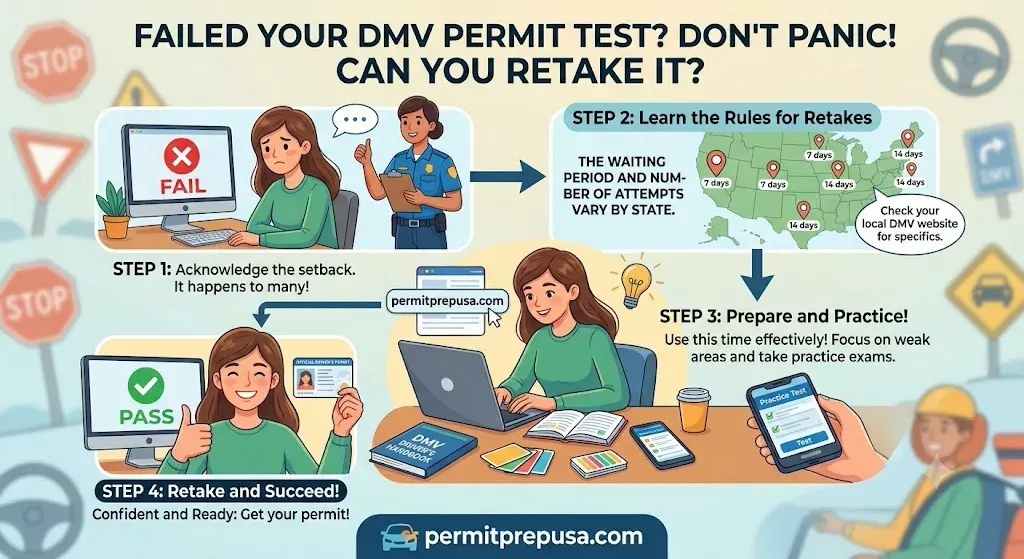
Quick-Answer Box: Yes, you can absolutely retake the DMV permit test if you fail. However, you cannot simply step to the back of the line and try again immediately. Most states operate on a "Three-Attempt Rule," meaning your initial application fee covers three tries. Before taking a retest, you will be subjected to a state-mandated waiting period—ranging from 24 hours to 7 days—and you will likely have to pay a small retesting fee (usually between $7 and $10). If you fail three times, your application is voided, and you must start the entire process over and pay a new application fee.
Every day, I watch applicants freeze up at our testing terminals. The timer ticks down, the pressure mounts, and eventually, the screen turns red, notifying them that they have exceeded their allowed mistakes. They walk back up to my counter, looking defeated, and ask the inevitable question: "Can I try again right now?"
As a DMV examiner, my answer is always the same: No, you cannot try again right now. The Department of Motor Vehicles does not allow applicants to brute-force the exam by guessing repeatedly until they get lucky. We enforce strict administrative penalty periods designed to force you out of our office and back into the driver's manual.
Failing the written knowledge test is incredibly common, but the aftermath is highly regulated. Let's pull back the curtain on the exact bureaucratic protocols that trigger the moment you fail, examine the specific waiting periods across major states, and outline the examiner's blueprint for ensuring your next attempt is your final one.
The Lock-Out: What Happens the Exact Moment You Fail
When you sit at one of our modern testing kiosks, the computer grades your answers in real-time. If you are taking a 50-question test and your state allows 10 mistakes, the system is constantly running the math. The exact second you submit your 11th incorrect answer, the testing software triggers an automatic lock-out protocol.
The screen will instantly terminate your session. You will not be allowed to see the remaining questions to "practice," nor will the system give you a detailed breakdown of every single rule you misunderstood. A failure receipt will print at my desk, and your digital driver profile will be flagged with an unsuccessful attempt.
At this point, you must collect your paperwork and leave the testing area. The clerical restrictions regarding how many questions can you miss on the permit test are absolute, and no examiner has the administrative authority to override the computer's lock-out.
The Universal Standard: The 3-Attempt Rule
While traffic laws vary by jurisdiction, almost every state DMV across the country utilizes the "Three-Attempt Rule" for licensing applications.
When you submit your paperwork and pay your initial processing fee (which generally ranges from $30 to $40), that fee legally covers the creation of your file and grants you a maximum of three opportunities to pass the written knowledge exam.
Here is how the progression works:
- Attempt 1: Covered by your initial application fee.
- Attempt 2 & 3: You are allowed to retest after serving a mandatory waiting period, but you will often have to pay a minor "re-examination fee" each time you sit at the kiosk.
- The 3-Strike Reset: If you fail the exam on your third attempt, your entire application file is legally voided. You must fill out a brand-new state application, provide all your identity documents again (just like we outlined in what to bring to your DMV permit test appointment), and pay a completely new, full-price application fee to restart the cycle.
State-by-State Waiting Periods & Fees
Because the DMV is a state-level agency, the penalty for failing the knowledge test fluctuates wildly depending on your zip code. Some states are lenient and allow you to return the very next morning, while others aggressively penalize failures to clear out their congested testing lobbies.
I have compiled the specific retake parameters for some of the largest jurisdictions into a mobile-friendly reference chart so you know exactly what penalties you face if you do not study.
| State Jurisdiction | Waiting Period & Retesting Fee |
|---|---|
| California (Minors) | 7-Day Wait Minors must wait a mandatory 7 days before retaking a failed knowledge test. |
| California (Adults) | No Mandatory Wait Adults can often retest sooner, but a re-examination fee applies to subsequent attempts. |
| Florida | Next Day Retake You can generally test again quickly, but Florida enforces a strict $10 fee for every Class E Knowledge Exam retest. |
| Texas | No Mandatory Wait You have 3 attempts within 90 days of your application. You can often retake it the next day if appointments are available. |
| New York | Next Day Retake No strict waiting period for the written test, but after failing the allowed attempts on an application, new fees apply. |
Examiner's Note: Even if your state allows you to retake the test the next day, you are still bound by the reality of office scheduling. Many DMV branches are booked solid for weeks. Failing your test means you might have to scour the online portal for days just to secure a new time slot.
Why Do DMVs Enforce a Penalty Waiting Period?
Applicants frequently complain to me about the 7-day waiting periods, calling them unfair or bureaucratic. They are neither. They are intentional safety mechanisms.
If you failed the test, it means you possess dangerous gaps in your understanding of the state driver's manual. You likely missed critical right-of-way protocols, misunderstood pavement markings, or failed to identify the correct fines for a DUI. Our agency cannot, in good conscience, let you back onto a terminal an hour later just to guess your way into a passing grade.
The waiting period is designed to force you to cool off, go home, and actually review the technical data. We want to ensure that before you ever ask can you take the DMV permit test online or attempt another in-person kiosk, you have genuinely repaired your structural knowledge.
An Examiner's Blueprint: What to Do Before Your Next Attempt
If you are currently holding a failure slip, do not panic, but do not ignore the warning sign either. You need to drastically alter how you approach the material. If you simply skim the book again, you will likely fail your second attempt.
Step 1: Execute a Diagnostic Extraction
While our computers will not give you the exact questions you missed, your failure receipt will often highlight the general categories where you lost points (e.g., "Road Signs" or "Speed Limits"). Use this data. Go straight to your official state manual and read those specific chapters cover-to-cover.
Step 2: Ditch the "Common Sense" Approach
If you failed, it is highly likely you relied on intuition rather than hard data. You must memorize the numbers. Highlight the exact braking distances, the specific suspension timelines, and the blood alcohol limits. These are the metrics that break score buffers.
Step 3: Leverage the 95% Simulator Rule
Do not book a new appointment until you have completely overhauled your DMV practice test strategy. Run full-length, state-specific diagnostic simulations in a quiet room without your notes. Do not return to our office until your practice dashboards consistently show a score of 95% or higher.
You already know exactly how hard is the DMV permit test because you have experienced the kiosk firsthand. Respect the evaluation, put in the required hours of focused study, and you will easily clear the terminal on your next attempt.
