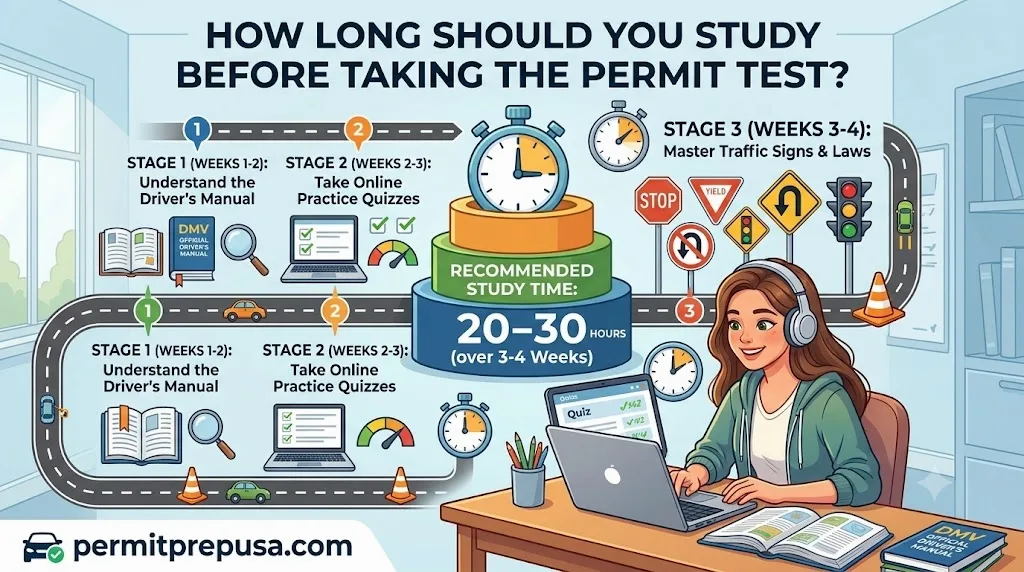
The Examiner’s Direct Answer: What Is the Ideal Preparation Window?
Quick-Answer Box: On average, you should study for **10 to 14 days** before taking your official DMV permit test, dedicating roughly **30 to 45 minutes per day** to the material. This equates to a total investment of **7 to 10 hours** of highly focused prep time. Cramming for 8 hours the night before does not work; your brain requires incremental daily pacing to successfully store granular technical data like stopping distances, fine brackets, and strict intersection right-of-way laws into long-term memory.
Every single week, I stand behind my counter and watch applicants make scheduling appointments with absolute disregard for a preparation timeline. Someone will walk into our lobby, check in for an exam, and casually mention they decided to book the test just two hours prior because they had a free afternoon. Unsurprisingly, these are the exact individuals who burn through their allowed score margins before they even reach the halfway mark of the evaluation.
As a DMV examiner, let me give you some blunt advice: time is either your greatest asset or your quickest route to an automatic lockout. The written knowledge test isn't something you can simply "wing" because you feel like you understand the general flow of traffic. It is a highly specialized legal assessment. If you do not give your brain the proper window of time to digest the regulatory data, our testing kiosks will fast-track you straight to a failure slip and a mandatory retesting penalty.
Let's map out the exact mathematical timeline required to build a flawless knowledge buffer, break down how to pace your study hours, and look at the real-world operational factors that dictate when you are genuinely ready to sit at our terminals.
The Dangerous Myth of the All-Night Cram Session
We live in a culture that treats cramming like a badge of honor. High school and college students assume that if they can stay up until 3:00 AM chugging energy drinks and staring at a textbook, they can walk into our office the next morning and ace the exam.
In our testing room, that strategy fails miserably. The reason is simple: cognitive stress and fatigue. When you cram, you are relying entirely on short-term working memory. The second you step into a cold government facility, stand in a long line, and face the psychological pressure of a real-time computerized grading terminal, your anxiety levels spike. Under stress, short-term memory is the very first system to compromise.
Furthermore, the data in your state manual is too dense for a single-night dump. You might memorize the basic color of a construction sign, but you will almost certainly confuse the exact feet required for signaling a turn or the statutory financial responsibility insurance limits. To understand the baseline architecture of what you are actually preparing for, it is incredibly helpful to read our complete analysis on what is the DMV permit test before setting your calendar.
The Mathematical Study Formula: Pacing vs. Total Hours
To successfully pass my terminal, your goal shouldn't be to hit a massive, exhausting number of study hours. It should be consistent, daily exposure. Studies in cognitive retention show that short, focused bursts of learning over a two-week period result in a 40% higher retention rate than a single block of marathon studying.
I recommend a baseline of **10 to 14 total days**. If you break that down into 30 to 45 minutes of daily, distraction-free study, you are only investing around 7 to 10 hours of cumulative time. This is a tiny price to pay to avoid the frustration of failing, paying retest fees, and driving back to our branch for a second attempt.
During this two-week window, your study sessions must be structured. If you spent the first week simply reading definitions, you haven't truly tested your recall. You must actively bridge your manual review with digital simulators. To understand how to execute this balance without wasting time, make sure to read our examiner's roadmap on how to study for the DMV permit test effectively.
The Mobile-Friendly 2-Week Study Blueprint
To ensure you are pacing yourself correctly without feeling overwhelmed, I have structured an examiner-approved preparation timeline into a clean, maximum two-column reference chart. This format lets you track your weekly developmental milestones right from your smartphone while planning your DMV calendar.
| Pacing Framework | Required Study Milestones & Actions |
|---|---|
| Week 1: Foundations (Days 1 - 7) |
Deconstruct the Manual: Spend 30 minutes a day reading chapters. Highlight exact numbers, speed bounds, and specific intersection rules. |
| Week 2: Diagnostic (Days 8 - 11) |
Run the 80/20 Strategy: Take full-length simulations. Extract your errors and map them directly back to the handbook text. |
| The Final Polish (Days 12 - 14) |
Lock in the Buffer: Achieve a 95% practice average. Memorize statutory fines and administrative restrictions. |
Variables That Can Change Your Needed Study Time
While the two-week window is the gold standard for most applicants, as an examiner, I recognize that certain personal variables can either accelerate or extend your required preparation time. You must audit your personal profile honestly before booking an open slot on our website:
Your Age Demographic
If you are a 16-year-old teenager, you are learning a completely foreign legal language. Concepts like right-of-way, blood alcohol tracking, and financial liability are entirely new to you. You will likely need the full 14 days. However, if you are a legal adult who has spent years navigating traffic as a passenger or cyclist, your baseline situational awareness is higher. An adult might comfortably master the material within 7 to 10 days of targeted reading.
Your State's Testing Blueprint
Difficulty isn't uniform across the country. The length of the test you face drastically alters your mathematical room for error. If you live in a state with a short, high-precision format or a long, stamina-driven exam, your timeline must adapt. For a deep dive into how your state's specific question pools impact overall test difficulty, read our detailed analysis on how hard is the DMV permit test.
The Diagnostic Test: How to Know You Are Ready
Do not let your calendar tell you when you are ready; let your data tell you. The ultimate metric of readiness is your running score average on high-quality, state-specific simulation software.
If your state requires an 80% to clear our counter, do not step foot in our lobby if you are only hitting an 80% at home. You are completely ignoring the "Anxiety Tax." The pressure of our facility will naturally drop your testing accuracy by roughly 10%. To see a live breakdown of passing bars across the country, reference our report on what score do you need to pass the DMV permit test.
You are officially ready to take the real test when you can sit down, open a fresh, randomized practice simulator pool you have never seen before, and easily score a 90% or 95% multiple times in a row. By building a knowledge cushion that massive, you guarantee that even if nerves cause you to make three or four silly mistakes at our kiosk, you will still sail past the passing threshold with room to spare.
An Examiner’s Closing Recommendation
Failing the knowledge exam is a monumental waste of your time and money. It forces you to log back into our glitchy state portals, struggle to find an open appointment, pay additional processing fees, and deal with the embarrassment of a failed mark.
Before you commit to a date, ensure you have established a proper tactical approach by reading our blueprint on the best DMV practice test strategy. Respect the material, dedicate 30 to 45 minutes of focused attention every single day for two weeks, and I guarantee you will pass my testing kiosk on your very first try.
