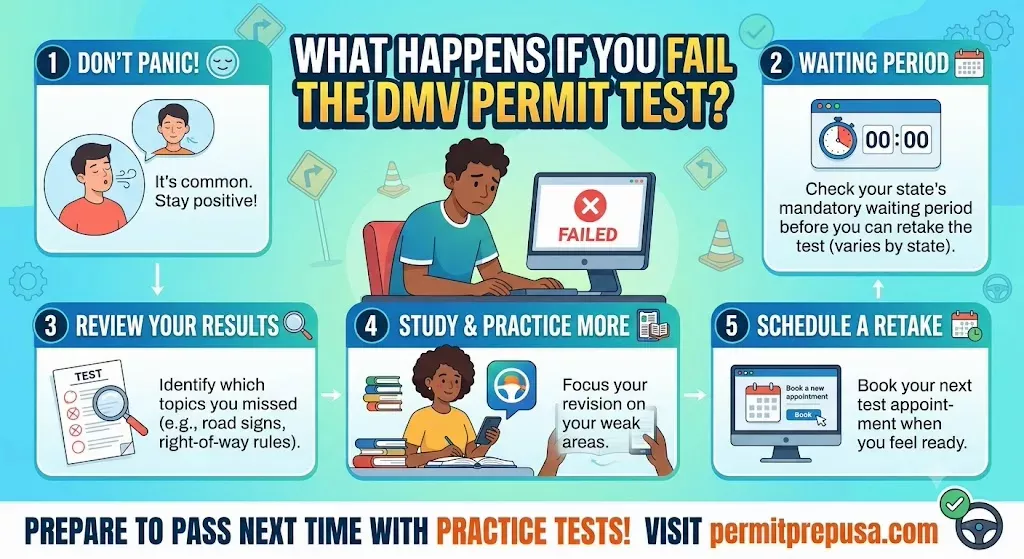
The Examiner’s Direct Answer: The Moment of Failure
Quick-Answer Box: If you fail the DMV permit test, the automated kiosk will immediately lock your screen and terminate the exam. Your failure is digitally logged into your state driver profile. You will be asked to return to the examiner's counter, where you will receive a failure receipt (often highlighting your weakest subjects). You cannot retake the test immediately. You must leave the office, serve a mandatory state waiting period (ranging from 24 hours to 7 days), and pay a small retesting fee upon your return for your next attempt.
Every day, I stand behind the main testing counter and watch the body language of applicants sitting at our computerized kiosks. I can always tell the exact second someone fails. Their shoulders drop, they stare blankly at the red notification on the monitor, and they slowly walk back to my desk looking completely defeated.
Failing the written knowledge exam feels like a massive personal setback, especially if you have spent weeks anticipating the freedom of driving. However, as a DMV examiner, I want to assure you that a failure is not a permanent mark against your character, nor does it mean you will never get a license. It is simply an administrative checkpoint.
To help you navigate the aftermath of a failed attempt without unnecessary panic, we need to look at exactly how our systems process a failure. Let's break down the immediate kiosk lock-out, the financial and temporal penalties that follow, and the exact steps you must take to ensure your next visit to our office is a successful one.
The Automated Lock-Out: What You See at the Kiosk
Modern DMV branches do not use paper tests graded with red pens. We use a real-time, digital grading algorithm. This software is completely devoid of emotion or context. It simply tracks your correct and incorrect inputs.
Because the system calculates your percentage live, the exam ends the exact millisecond a passing score becomes mathematically impossible. If your state requires an 80% on a 50-question test, you are allowed exactly 10 mistakes. The moment you click your 11th incorrect answer, the terminal triggers an automatic termination sequence.
Here is exactly what happens in that moment:
- The Screen Freezes: You will not be allowed to finish the remaining questions. The system prevents you from using the rest of the exam as "practice" to protect the integrity of our randomized question database.
- The Profile Flag: The kiosk sends a digital signal back to the main server, tagging your unique applicant ID with a failed attempt.
- The Return Prompt: The screen will instruct you to collect your belongings and return to the main examiner's counter.
Many applicants try to argue with me at the counter, claiming they accidentally clicked the wrong button. I have to inform them that our administrative rules are absolute. Once the computer logs the failure, no examiner has the authority to reverse it or grant a "mulligan." If you are curious about the precise limits of these attempts, you should read our comprehensive guide on how many times can you fail the permit test.
The Administrative Fallout: Waiting Periods and Penalty Fees
Once you return to my counter, I will hand you a failure receipt. This piece of paper is crucial. While it will not give you the exact questions you missed, it will often break down your performance by category (e.g., "Road Signs: 60%, Traffic Laws: 75%").
At this stage, you are subject to the state's penalty protocols. The DMV enforces these penalties to ensure applicants do not simply treat the exam like a slot machine, guessing repeatedly until they get lucky. You will face two distinct hurdles: a time penalty and a financial penalty.
I have structured a mobile-friendly breakdown of what happens in several major jurisdictions immediately following a failure.
| State Jurisdiction | Immediate Penalty Protocol |
|---|---|
| California (Minors) | 7-Day Lockout: The system blocks any retake for exactly one week. A retest fee is applied. |
| California (Adults) | Fee Assessment: No strict 7-day wait, but you must pay a re-examination fee to try again. |
| Texas | Next Available Slot: You can retest as soon as the next day, assuming the office has open appointments. |
| Florida | Financial Penalty: You can retest quickly, but every subsequent attempt incurs a strict $10 fee. |
| New York | No Immediate Fee: Your initial fee covers the test, but repeated failures will eventually require a new application. |
It is important to remember that even if a state technically allows you to test the very next day, physical branch logistics often prevent it. Most DMV offices are booked solid. Failing today might mean you cannot secure another appointment for two to three weeks.
Will a Failure Go on My Permanent Driving Record?
This is a major source of anxiety for first-time drivers. They worry that a failed permit test will permanently stain their driving abstract, leading to higher insurance rates or future scrutiny from law enforcement.
Let me put your mind at ease: A failed knowledge test does not appear on your public driving record.
Your driving record (or Motor Vehicle Report) tracks moving violations, license suspensions, and accident fault. It does not track academic struggles at our kiosks. The failure is only logged internally within our DMV application database to track your active fee status and your 3-attempt limit. Once you eventually pass the exam and earn your license, those previous failures become completely irrelevant outside of our internal clerical system.
The Psychological Toll: Don't Let Panic Ruin Your Next Try
Failing the test fundamentally alters how an applicant approaches their next attempt. When you sit down at the kiosk for your second try, you carry the heavy baggage of the previous failure. The moment the computer flags your first incorrect answer, the anxiety spikes exponentially.
This panic leads to the "Speed-Reading Trap." Terrified of running out of time or making another mistake, applicants rush through the text. They miss critical modifiers like "EXCEPT" or "ALWAYS." To understand just how heavily the exam relies on these linguistic parameters, you must comprehend how hard is the DMV permit test fundamentally.
If you let the terminal psych you out, your second attempt will end exactly like your first. You must treat the retake as a completely clean slate. Ignore the pressure of the previous lockout and focus entirely on the legal parameters of the question currently on your screen.
The Examiner's Step-by-Step Recovery Plan
If you walked out of our office today with a failure receipt, your preparation strategy needs a complete overhaul. The methods you used previously are demonstrably flawed. To guarantee you pass on your next visit, execute this strict recovery plan:
Step 1: Audit Your Failure Receipt
Look at the printed receipt I handed you. If it shows you failed the "Road Signs" category, you must accept that you have a structural weakness in that area. Open your state driver's manual immediately to that specific chapter. Do not waste time re-reading sections you already understand; aggressively target the data points that defeated you.
Step 2: Review the Retake Rules
Before you jump back onto the scheduling portal, make sure you legally understand your standing. Are you on your second attempt or your third? If you are on your third, a failure will void your entire application. Read our detailed explanation on can you retake the DMV permit test if you fail so you are fully aware of the stakes.
Step 3: Implement a Zero-Note Testing Strategy
You cannot study casually anymore. You must simulate the exact pressure of our physical office. Log onto a high-quality practice simulator and run a full-length diagnostic test. Do not look at your manual, do not look at your phone, and set a timer.
You must employ the best DMV practice test strategy available: test, identify errors, read the manual, repeat. Do not return to my counter until your simulator dashboard consistently registers a 95% or higher. When you respect the metrics and build a massive safety margin at home, your next visit to the DMV will end with a freshly printed learner's permit in your hand.
