The Examiner’s Direct Answer: Where Do Most Applicants Fail?
Quick-Answer Box: The most common mistakes on the DMV permit test are completely avoidable. They include 1) rushing through questions and misreading modifier words like "NOT" or "EXCEPT," 2) relying on general common sense instead of memorizing exact numerical laws (like BAC limits and stopping distances), 3) fundamentally misunderstanding uncontrolled intersection right-of-way protocols, and 4) letting the real-time grading terminal induce severe test anxiety that ruins their score buffer.
Every morning, I unlock the doors to our DMV branch, turn on the automated testing kiosks, and watch a steady stream of first-time drivers step up to the terminals. Whether they are sixteen-year-old high school students or adults applying for their first license, the anxiety is palpable. And every single day, I watch perfectly capable, intelligent people fail the written knowledge exam.
The tragic part? They rarely fail because the test is impossibly tricky. They fail because they make the exact same predictable, structural errors as the thousands of applicants who tested before them. As a DMV examiner, my goal is to process competent drivers, not to hand out failure slips. I want you to pass.
To help you protect your score, I have compiled an insider's report on the most frequent, critical mistakes that destroy an applicant's passing margin. Let's break down these common traps, examine why they happen, and outline the precise strategies you need to bypass them.
Mistake 1: The "Speed-Reading" Trap
The number one reason people miss questions they actually know the answer to is raw speed. When an applicant sits at a government terminal with a clock ticking down on the screen, adrenaline kicks in. They want to get the uncomfortable experience over with as quickly as possible. As a result, they skim the questions rather than reading them.
Our testing databases are meticulously written by legal administrators. The questions are not meant to trick you, but they demand absolute precision. If you read too fast, your brain will automatically skip over vital modifier words.
Consider the difference between these two prompts:
- "Which of the following is a legal place to park?"
- "Which of the following is NOT a legal place to park?"
If you miss the word "NOT," "EXCEPT," "ALWAYS," or "NEVER," you will confidently select the exact opposite of the correct answer. You just burned a point off your safety margin purely due to carelessness. Slow down. Read every question twice, and read every single multiple-choice option before clicking the mouse.
Mistake 2: Ignoring the Hard Numbers
We discussed this heavily in our guide analyzing can you pass the DMV permit test without reading the manual, but it bears repeating: you cannot guess the numbers.
A massive portion of our failure rate comes from applicants who try to apply general "common sense" to highly specific statutory laws. You might know that drinking and driving is illegal, but the kiosk is going to ask you for the exact Blood Alcohol Concentration (BAC) threshold that constitutes a DUI for a driver under the age of 21.
If you haven't memorized the hard data, you will be forced to guess between 100 feet and 200 feet for a turn signal requirement, or between 15 days and 30 days for notifying the DMV of an address change. These questions are heavily weighted in the testing pool, and fumbling the numbers is a surefire way to be locked out of the terminal.
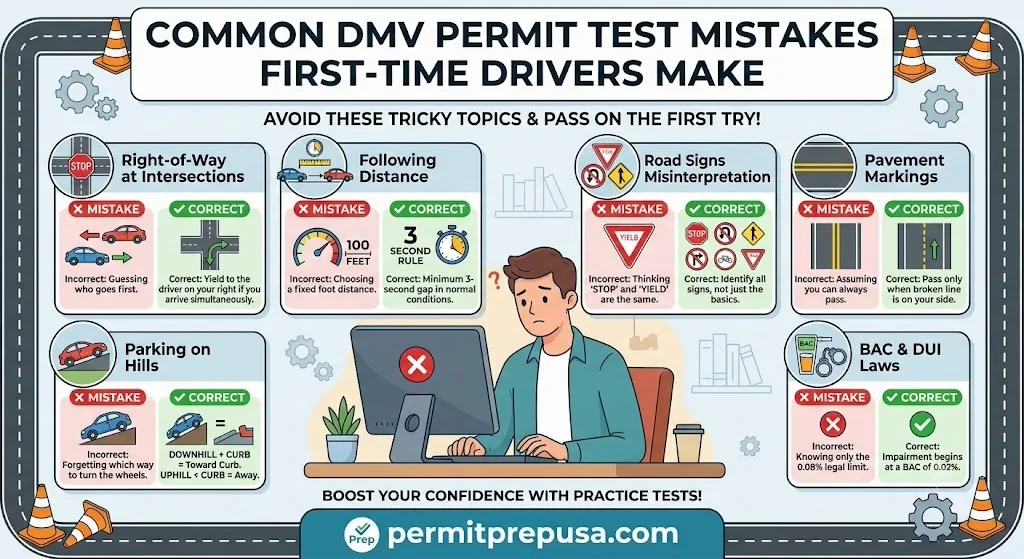
Mistake 3: Right-of-Way Confusion at Intersections
Intersections are statistically the most dangerous environments on the road. Consequently, our exams are heavily loaded with complex right-of-way scenarios. Many first-time drivers understand a basic traffic light, but they completely freeze when presented with an uncontrolled four-way stop.
The mistake here is assuming that right-of-way is a matter of politeness. It is not; it is a strict legal hierarchy. You will be asked questions such as:
- If two vehicles arrive at a four-way stop at the exact same time, who yields? (Answer: The driver on the left must yield to the driver on the right).
- When making a left turn on a solid green light (not a green arrow), do you have the right of way over oncoming straight traffic? (Answer: No, you must yield to oncoming traffic).
If you do not have the right-of-way hierarchy completely memorized, including pedestrian laws at unmarked crosswalks, you will lose a massive chunk of your score buffer.
Mistake 4: Misinterpreting Pavement Paint
First-time drivers spend hours memorizing the shape of a stop sign, but they completely ignore the paint on the ground. Pavement markings are legally enforceable traffic signs, and confusing them is a critical error.
The terminal will show you a graphic of a road and ask you if you can legally pass the car in front of you. If you do not know the strict legal difference between a broken yellow line (passing allowed if safe), a solid yellow line (no passing), and double solid white lines (lane changing strictly prohibited), you will fail those scenarios instantly. Treat pavement markings with the exact same respect as metal road signs during your study sessions.
The Examiner's Quick-Fix Reference Chart
To help you audit your own study habits, I have condensed the most common kiosk errors into a streamlined, mobile-friendly two-column table. Review this checklist before you finalize your DMV appointment.
| The Common Mistake | The Examiner's Fix |
|---|---|
| Rushing and Skimming Missing words like "NOT" or "EXCEPT". |
Enforce a Delay: Take your hands off the mouse. Read the prompt twice before looking at the answers. |
| Guessing Traffic Fines Assuming penalties are "common sense." |
Memorize the Metrics: Highlight and memorize exact BAC limits, suspension days, and fine amounts in your manual. |
| Right-of-Way Confusion Failing four-way stop questions. |
Learn the Hierarchy: Study the "first to arrive" and "yield to the right" rules until they are second nature. |
| Sectional Ignorance Ignoring the road sign category. |
Check Your State Laws: Know if your state enforces an automatic fail for missing too many road signs. |
Mistake 5: Letting the Terminal Psych You Out
There is a massive psychological component to taking a test in a government building. Modern DMV kiosks utilize real-time grading systems. This means that the exact moment you click a wrong answer, the screen will flash, log the error, and update your running mistake counter.
For many first-time drivers, seeing that first red "X" causes a cascade of panic. They realize their safety buffer just shrank. This anxiety causes them to rush the next question, which leads to another mistake, creating a rapid downward spiral.
You must understand the mathematical reality of the exam. You are allowed to make mistakes. If you want to know exactly how much breathing room you have, review our examiner's breakdown on how many questions can you miss on the permit test. If you miss a question early on, take a deep breath. Do not let one error destroy your focus for the remaining forty questions.
Mistake 6: Practicing with Open Notes
This is a preparation error that ruins applicants before they even reach my counter. When students study at home, they often take online simulators with their state handbook sitting open on their laps. If they get stuck, they quickly peek at the book to find the answer, and then pat themselves on the back for scoring a 95%.
This creates a total illusion of competence. When you step up to our kiosk, you are strictly forbidden from having any notes, phones, or reference materials. If you have not trained your brain to retrieve information under pressure without a safety net, you will blank out completely.
To avoid this, you must read our detailed breakdown on what score do you need to pass the DMV permit test, and ensure you are consistently hitting that exact target score on your practice tests in a strictly timed, closed-book environment.
Final Thoughts for First-Time Drivers
The written knowledge exam is designed to be challenging. It acts as a necessary filter to keep untrained drivers off our public roads. However, it is not an insurmountable hurdle. If you understand how hard is the DMV permit test from a structural standpoint, you can prepare accordingly.
Avoid the arrogance of common sense, read your questions carefully, memorize the hard data points, and train your brain under real-world conditions. If you can eliminate these common unforced errors from your testing strategy, I guarantee you will only have to visit my testing counter once.
