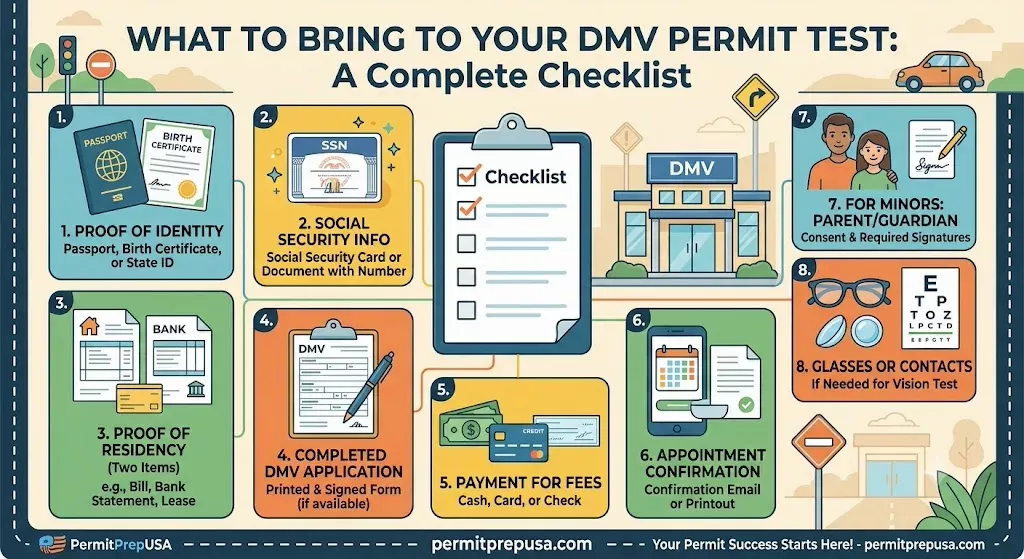
The Examiner’s Direct Answer: The Essential Document Checklist
Quick-Answer Box: To take your DMV permit test, you must bring original, physical documents to prove your identity and residency. Generally, you need: 1) Proof of Identity and Lawful Presence (e.g., an unexpired U.S. Passport or original Birth Certificate), 2) Proof of your Social Security Number (e.g., your actual SSN card or a recent W-2 form), 3) Two proofs of physical state residency (e.g., utility bills or bank statements in your name), and 4) The required application fee. If you are under 18, you must also bring a signed parental consent form and, depending on your state, proof of driver's education enrollment.
There is a specific kind of heartbreak I witness at my DMV testing counter every single day. An applicant walks in fully prepared. They have spent weeks studying the manual, they have perfected their DMV practice test strategy, and they are mathematically ready to pass the exam. But when they step up to my window, I have to turn them away before they even touch a computer terminal.
Why? Because they brought a photocopy of their birth certificate instead of the original, or they forgot their Social Security card, or their proof of residency doesn't have their name on it.
The Department of Motor Vehicles is a strict regulatory agency. We issue state and federally recognized identification. Because of this, our document verification process is incredibly rigid. We do not make exceptions, we do not accept digital photos of documents on your smartphone, and we do not care if you drove two hours to get to our office. If your paperwork is not perfect, you are going home.
Let's completely eliminate that risk. Before you even start worrying about what score do you need to pass the DMV permit test, you need to ensure you can actually sit for the exam. Here is the examiner-approved breakdown of exactly what you need to bring to your appointment.
The REAL ID Standard: Why We Are So Strict
To understand why the DMV demands such specific paperwork, you have to understand the REAL ID Act. Enacted by the federal government, this law set new security standards for state-issued driver's licenses and permits. It requires us to establish a verifiable, unbroken paper trail proving exactly who you are, that you are legally allowed to be in the United States, and that you actually live in the state where you are applying.
Because your learner's permit is the first step toward a full REAL ID-compliant driver's license, the document check at the permit phase is intense. You cannot bring photocopies, laminated documents (which obscure security watermarks), or expired IDs. Everything must be an original or a certified copy issued directly by the governing agency.
Category 1: Proof of Identity and Legal Presence
This is the most critical document you will present. You must prove your legal name and your date of birth. You only need to bring one of the following primary documents, but it must be flawless:
- Original U.S. Birth Certificate: It must be issued by a state or local government agency and feature a raised, embossed, or multi-colored seal. Hospital-issued birth certificates (the ones with the baby footprints) are never accepted.
- Unexpired U.S. Passport or Passport Card: This is the easiest and most preferred document.
- Certificate of Naturalization or Citizenship.
- Unexpired Permanent Resident Card (Green Card) or Employment Authorization Document (EAD).
Examiner's Warning on Name Changes: If your current legal name does not perfectly match the name on your birth certificate or passport (due to marriage, divorce, or adoption), you must bring the official linking documents. This means bringing the original, certified marriage certificate or court order proving your name change. If the names don't match and you have no proof of why, I cannot process your application.
Category 2: Proof of Social Security Number (SSN)
State DMVs run your information through federal databases to verify your identity. Therefore, we need proof of your SSN. Do not just memorize the nine digits; you must bring physical proof. Bring one of the following:
- Original Social Security Card: It cannot be laminated, ripped in half, or a photocopy.
- W-2 Form: From your employer, issued within the last tax year, showing your full SSN.
- Paystub: Must include your full name and your full SSN (not just the last four digits).
- 1099 Form: Issued within the last tax year.
Category 3: Two Proofs of Residential Address
You can only get a permit in the state where you actually live. Therefore, you must prove your physical residential address. P.O. Boxes are strictly prohibited for this requirement. You typically need to bring two different documents from different sources. Examples include:
- A recent utility bill (water, gas, electric, internet) issued within the last 60 to 90 days.
- A bank statement or credit card bill.
- A current lease agreement or mortgage statement signed by you.
- An official piece of mail from a government agency (like a tax bill or jury duty summons).
Important Note for Teenagers: Minors rarely have utility bills or leases in their name. If you are under 18, the DMV usually allows your parent or legal guardian to present two proofs of residency in their name, provided they are present with you at the counter and can prove their relationship to you (via your birth certificate).
Special Requirements for Minors (Under 18)
If you are a teenager, your documentation requirements are significantly heavier. The state views you as a liability risk, so parents and schools must be involved. In addition to your identity documents, you must bring:
- Signed Parental Consent Form: Your parent or legal guardian must sign your permit application. In most states, they must do this in person in front of a DMV examiner. If they cannot come with you, the form usually requires a notarized signature.
- Proof of Driver's Education Enrollment/Completion: In states like California and Texas, minors cannot even take the written test without proving they have finished or are actively enrolled in an approved classroom driver's education course. You must bring the official blue, pink, or white certificate issued by your driving school.
- School Attendance Verification: Some jurisdictions (like Georgia) require a form signed by your high school proving you are actively enrolled and have good attendance.
The Examiner's Preparation Matrix
To help you organize your folder before you leave the house, I have formatted this information into a streamlined, mobile-friendly checklist. Cross-reference this before you walk out the door. Before you arrive, make sure you also understand exactly what is the DMV permit test so you know the format of the exam you are about to take.
| Document Category | Acceptable Physical Examples (No Copies) |
|---|---|
| 1. Identity & Lawful Presence (Bring One) |
U.S. Passport or Birth Certificate Must have a raised seal. No hospital prints. |
| 2. Social Security Number (Bring One) |
SSN Card or Recent W-2 Must display the full 9-digit number clearly. |
| 3. State Residency (Bring Two) |
Utility Bills or Bank Statements Must show your physical address, not a P.O. Box. |
| 4. Teenager Requirements (If Under 18) |
Parental Consent & Driver's Ed Certificate Parent must typically sign in front of the examiner. |
| 5. Payment Method (Required for all) |
Debit Card, Cash, or Check Check your local DMV for exact accepted fee methods. |
The Vision Test and The Application Form
When you arrive, bringing your documents is only the first phase. You will also be handed a state permit application (if you haven't already filled one out online). You must fill this out entirely in black or blue ink, without crossing things out.
Before I allow you to walk over to the testing kiosks to face the questions you studied so hard for, I will make you look into a vision screening machine. The state must verify your eyesight meets the minimum safety threshold (usually 20/40 vision). If you wear glasses or contact lenses, bring them to your appointment. If you fail the vision test, you cannot take the written test, regardless of how well you understand the traffic laws.
The testing environment is strict, and many applicants wonder how hard is the DMV permit test once they actually sit down. The difficulty of the questions will be the least of your worries if you are stressed about your paperwork. Keep your documents in a clean folder, bring your payment, and you will transition smoothly from the clerical counter straight to a passing score.
