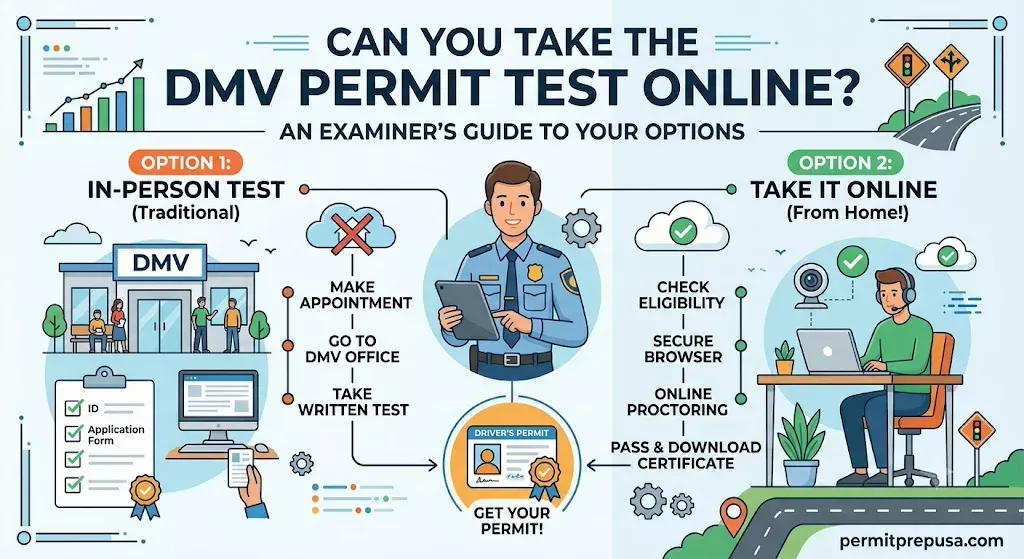
The Examiner’s Direct Answer: Can You Test From Your Couch?
Quick-Answer Box: Yes, you can take the DMV permit test online, but **it depends entirely on your state and your age**. Major states like Florida, California, Texas, Arizona, and Ohio allow eligible applicants (often minors under 18) to take the knowledge exam online through certified proctored systems or approved third-party providers. However, many major jurisdictions—including Pennsylvania, Illinois, New Jersey, and Michigan—still strictly mandate that you test in-person at a physical branch kiosk.
Every single day, applicants walk up to my window holding a stack of paperwork, looking completely exhausted. They look around our crowded lobby, sigh deeply, and ask me the exact same question: "Examiner, is there any way I could have just done this written test online from home?"
As a DMV examiner, I completely understand the desire to bypass our waiting rooms. Historically, the answer was a flat no; you had to sit at one of our physical terminals to prove your knowledge. However, modern automated infrastructure has shifted dramatically. Today, many state motor vehicle departments have launched secure remote testing platforms.
But do not mistake convenience for a lack of regulation. Taking the exam from your living room does not mean the rules are relaxed. In fact, our online proctoring frameworks are incredibly strict to prevent cheating. Let's deconstruct exactly how online permit testing works, map out the comprehensive stance of 15 major states leading or resisting the digital shift, and examine the security protocols that monitor your every move.
State-by-State Reality: The 15-State Breakdown
Because licensing is governed at the state level, there is no single national network for online exams. Every state writes its own digital rules, and many split their permissions based on the applicant's age demographic.
Minors and adults face completely different entry portals depending on the jurisdiction. For instance, if you are analyzing the operational guidelines in Arizona, the state permits teens under 18 to take the "Permit Test @ Home" supervised by a parent via their MVD Now account. Similarly, Ohio utilizes a secure online testing portal called "KnowTo Drive". However, if you live in Illinois or Pennsylvania, you have no choice but to visit a physical office.
To give you a definitive view of your options, I have expanded our internal testing logs into a comprehensive, mobile-friendly reference table covering 15 of the most populated U.S. jurisdictions and their current online testing status.
| State Jurisdiction | Online Permit Testing Allowance |
|---|---|
| 1. California | Available for All Ages: Minors and adults can take an online proctored exam via the DMV portal. |
| 2. Texas | Available via Driver's Ed: Online testing is integrated into state-approved teen and adult Driver's Ed courses. |
| 3. Florida | Available for Minors: Applicants under 18 can test online via state-approved third-party apps. |
| 4. New York | Available for Adults (18+): Adults test online via NY.gov. Minors must use school portals or test in-person. |
| 5. Arizona | Available for Minors: Permit Test @ Home allows teens to test via parent supervision. |
| 6. Ohio | Available via BMV Portal: Applicants can use the KnowTo Drive online testing system. |
| 7. Pennsylvania | In-Person Only: Strictly mandates all knowledge exams be taken at a physical branch kiosk. |
| 8. Illinois | In-Person Only: No general public online option; all tests are conducted at SOS facilities. |
| 9. Georgia | In-Person Only: Must be taken at a DDS Customer Service Center (some 3rd party school exceptions). |
| 10. Nevada | In-Person Only: The general public must schedule an appointment at an official DMV office. |
| 11. Virginia | In-Person / High School Only: No home testing; must test at the DMV or via approved high school proctors. |
| 12. North Carolina | In-Person Only: Requires applicants to visit a physical NCDMV office for the knowledge test. |
| 13. Michigan | In-Person Only: All tests must be taken at a Secretary of State branch office. |
| 14. Washington | Approved Schools / In-Person: Tested via approved driving training schools; not directly from a home laptop. |
| 15. New Jersey | In-Person Only: NJ MVC mandates all testing be completed at authorized state testing centers. |
The Tech Reality: How the DMV Monitors You at Home
The most common misconception I hear is that taking the test online makes it easy to cheat. Applicants assume that because I am not standing directly behind them, they can simply open their state driver's manual on a separate screen or have a parent whisper the answers from across the room.
Let me disabuse you of that notion immediately. Our remote testing platforms use advanced biometric proctoring software. When you log into the secure exam terminal, you must grant the system absolute access to your computer's webcam, microphone, and browser environment.
Here is what happens behind the scenes while you are answering questions:
- Continuous Identity Verification: Before the test begins, you must hold your passport or birth certificate up to the lens to verify your identity, matching the exact records of what to bring to your DMV permit test appointment. Throughout the test, facial-recognition algorithms confirm that the person answering the questions remains the applicant.
- Browser Lockdowns: The testing software completely freezes your browser. You cannot open new tabs, access search engines, or minimize the window. If you attempt to switch screens, the test terminates instantly, registering an automatic failure.
- Environmental Audio & Video Audits: The software continuously tracks your eye movements. If your gaze repeatedly drifts away from the monitor (suggesting you are looking at hidden notes), the system flags the session for fraudulent activity. Furthermore, the microphone listens for ambient speech. If it detects another voice providing answers, the session is blocked.
If the proctoring software flags your session for irregular behavior, a live examiner like me will manually review the recording. If we determine you cheated, your test score is permanently erased, and you may face a long-term administrative ban from applying for a license.
The Exam Metrics Don't Change Online
Transitioning from a physical kiosk to a home computer does not change the structural parameters of the evaluation. The question banks are exactly the same. You face the identical volume of questions, the same passing thresholds, and the exact same room for error as an applicant sitting in our office.
If you choose to test online, you must still be aware of the mathematical margins. A careless error at home lowers your safety cushion just as quickly as a mistake at our branch counter. Before you begin clicking, ensure you know precisely how many questions can you miss on the permit test to avoid triggering an automatic lockout script.
Furthermore, the inherent difficulty of the technical concepts remains completely static. The software will still test you on precise numbers, fine brackets, and legal hierarchies. If you haven't built a deep structural foundation, the online environment will not save you. Take the time to deconstruct how hard is the DMV permit test so you don't underestimate the material simply because it is displayed on a personal laptop.
What Happens After You Pass the Online Exam?
Passing the test online is a massive milestone, but it does not mean your permit magically appears in your mailbox. The online system merely registers a passing credit to your state driver profile.
To finalize the administrative loop and legally receive your physical paper permit card, you must still physically visit a local DMV office. However, because your knowledge test credit is already verified in our secure system, your wait time at our counter drops significantly.
When you arrive at our branch to claim your permit, you must be prepared to execute the remaining clerical steps: passing a mandatory vision screening, taking your official driver's license photograph, and finalizing your state processing fees. If you try to bypass the prep and end up failing the online portion, you will be forced to wait for a penalty period, which is why it helps to review exactly how long should you study before taking the permit test.
An Examiner's Blueprint for Remote Testing Success
If your state allows remote options and you choose to test from home, you must treat the process with absolute professionalism. Do not treat it casually.
Ensure you have a reliable, high-speed internet connection and a completely quiet room with clear lighting so the webcam can trace your facial metrics perfectly. Most importantly, do not skip active preparation. Before you initiate the live proctoring stream, verify your knowledge by utilizing a rigorous, structured best DMV practice test strategy. Achieve a consistent 95% scoring average on closed-book simulators at home, clear the remote proctoring gates, and your final counter visit to collect your learner's permit will be a seamless success.