The Examiner’s Direct Answer: The Legal Age Limit
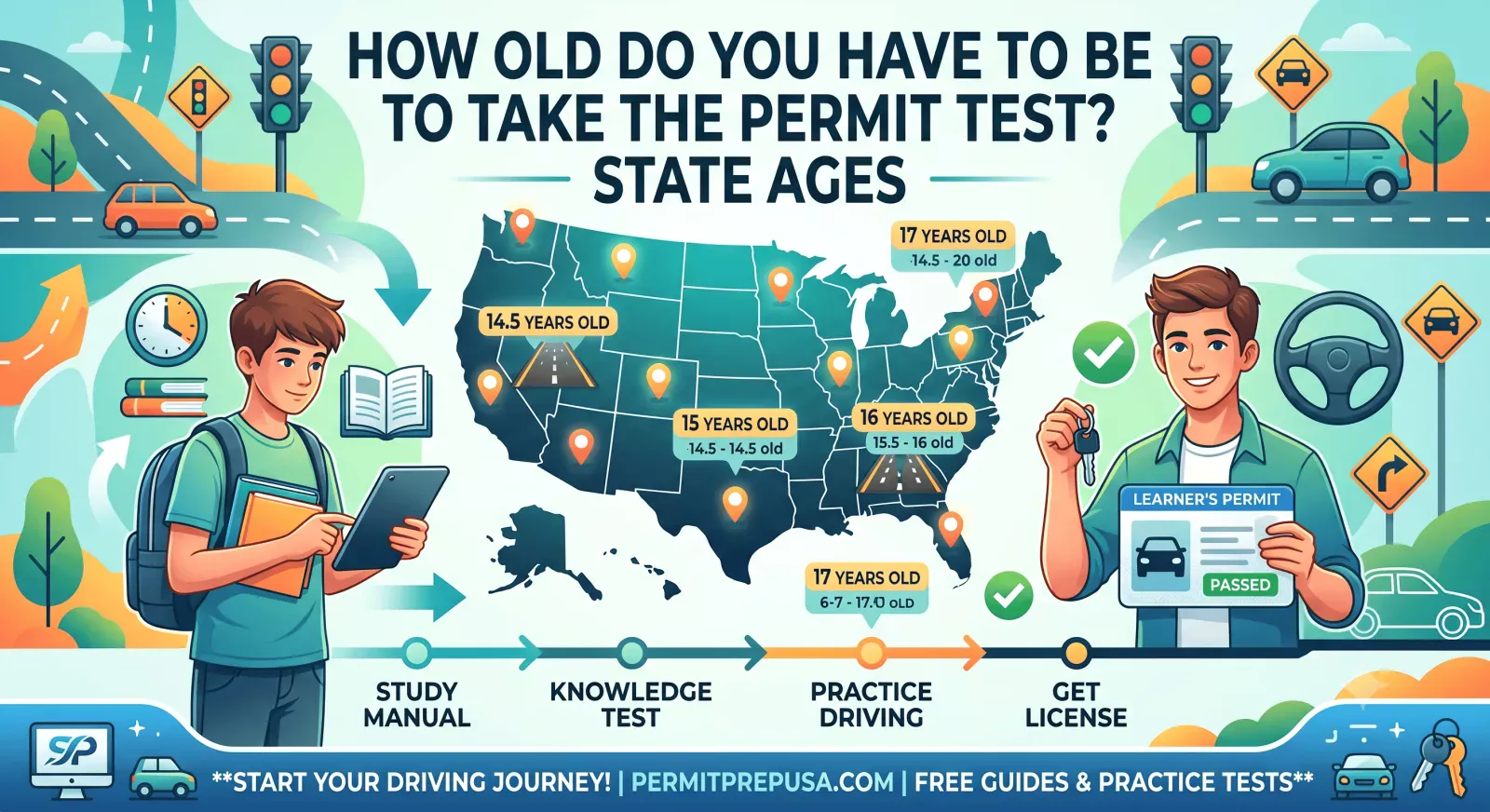
Quick-Answer Box: In the majority of U.S. states, you must be exactly 15 years old to take the DMV permit test. However, the legal minimum age varies significantly by jurisdiction, ranging from 14 years old in states like South Dakota, North Dakota, and Iowa, to 16 years old in states like New York, Pennsylvania, and New Jersey. You cannot take the exam even one day before your state's legal minimum age requirement.
One of the most frustrating parts of my job as a DMV examiner is having to turn away an excited teenager who has been studying for weeks, simply because they misunderstood the calendar. I have had parents argue with me at the counter, insisting that because their child's birthday is "next week," we should just let them take the written exam early so they can get a head start.
The Department of Motor Vehicles does not negotiate with the calendar. Your age is a strict statutory requirement tied directly to public safety laws. Our computer systems will physically lock me out of generating your application file if your verified date of birth does not meet the exact minimum age down to the day.
Before you start worrying about how hard is the DMV permit test, you must verify that you are legally eligible to sit at the terminal. Let's break down the national age landscape, examine the strict Graduated Driver Licensing (GDL) laws that dictate teenage driving, and look at exactly what minor applicants need to bring to the counter.
The Graduated Driver Licensing (GDL) System
If you are a teenager applying for a permit, you are entering what the government calls the Graduated Driver Licensing (GDL) program. Enforced in all 50 states, the GDL is a multi-stage system designed to slowly introduce minors to the dangers of the road under strict supervision before granting them full driving privileges.
The system is broken down into three distinct phases:
- Phase 1: The Learner's Permit (Supervised Driving)
This is the stage you are currently applying for. It strictly requires a licensed adult (usually 21 or older) to be in the front passenger seat at all times. - Phase 2: The Provisional / Intermediate License
After holding your permit for a mandatory period (usually 6 to 12 months) and passing a road test, you can drive alone, but with strict curfews and passenger limits. - Phase 3: The Full Unrestricted License
Typically granted when the driver turns 18 and has maintained a clean driving record.
Because the GDL phases are locked behind mandatory holding periods, the age you get your permit directly impacts the age you can legally drive yourself to school or work. If your state requires you to hold a permit for a full year, getting it at exactly 15 means you can drive alone at 16. If you delay taking the knowledge test, your entire timeline shifts backward.
State-by-State Minimum Age Guide
Because the GDL program is managed at the state level, the entry age for a learner's permit fluctuates dramatically depending on where you live. Some rural states allow teens to begin driving earlier to help with agricultural work, while highly congested metropolitan states delay the driving age to reduce accident rates.
To help you plan your DMV appointment, I have broken down the minimum age requirements into a streamlined, mobile-friendly two-column chart covering various regions of the country.
| Legal Minimum Age | State Jurisdictions (Examples) |
|---|---|
| 14 Years Old | Alaska, Arkansas, Iowa, North Dakota, South Dakota, Kansas. |
| 15 Years Old (The National Average) |
Florida, Texas, Georgia, Illinois, North Carolina, Colorado, Maryland. |
| 15 ½ Years Old (15 Years, 6 Months) | California, Ohio, Nevada, Wisconsin, Virginia. |
| 16 Years Old | New York, Pennsylvania, New Jersey, Massachusetts, Connecticut. |
Examiner's Warning: Never rely on hearsay from friends or relatives who live in another state. If your cousin in Florida got their permit at 15, that has absolutely zero bearing if you are walking up to my testing counter in California, where you must be precisely 15 and a half.
What Minors Must Provide Besides Their Age
Being old enough is only the first hurdle. If you are under the age of 18, the state views you as a high-risk liability. You cannot simply walk into the branch, hand me a birth certificate, and demand a test. Your application must be heavily reinforced by adults.
Before you even ask yourself how much does the DMV permit test cost, you must ensure you have the following components ready:
- Parental Consent: Minors cannot enter into legal contracts with the state. Your parent or legal guardian must physically accompany you to the DMV to sign your application and assume financial liability. If they cannot be there, you must bring a strictly notarized state consent form.
- Driver's Education Enrollment: In strict states like California or Texas, being 15 or 15 ½ is not enough. You must also bring an official certificate proving you have enrolled in or completed a state-approved classroom Driver's Education course. Without this certificate, I will not unlock the testing terminal.
- School Attendance Records: Several jurisdictions require minors to prove they are actively enrolled in high school and maintaining acceptable attendance. If you have dropped out, some states will outright deny your permit application.
For a flawless breakdown of every physical paper you need to carry into the building, review our comprehensive checklist on what to bring to your DMV permit test appointment.
Are the Rules Different for Adults (18+)?
Yes, significantly. Once you turn 18, you age out of the restrictive Graduated Driver Licensing program. The state recognizes you as a legal adult capable of assuming your own liability.
If you are applying for your first permit at 18, 25, or 40, you do not need parental consent, and you generally do not need to prove enrollment in a Driver's Ed classroom course. However, you are still legally required to obtain a learner's permit before you can take a road test.
Furthermore, adult applicants must pass the exact same knowledge evaluation. The fines, the rules of the road, and the right-of-way hierarchies remain identical. While you might face a slightly shorter version of the exam in some states, you are still bound by the same scoring margins. You should intimately understand what score do you need to pass the DMV permit test before attempting to bypass the manual just because you are an adult.
An Examiner's Final Warning Before You Apply
Do not book your appointment on the exact day of your minimum age birthday unless you have thoroughly prepared. I have seen hundreds of 15-year-olds celebrate their birthday by failing the written exam at 9:00 AM because they were too excited about the milestone and completely ignored the driver's manual.
Failing on your birthday triggers the exact same administrative lockouts and penalties as any other day. Read our guide on what happens if you fail the DMV permit test to understand the waiting periods you will face.
If you want to walk out of our office with a permit in your hand, check your state's exact age bracket, gather your parental signatures, and spend two weeks running high-quality practice simulators. When you combine legal eligibility with true preparedness, passing the exam becomes a seamless formality.
