The Examiner’s Direct Answer: What Is the Price Tag?
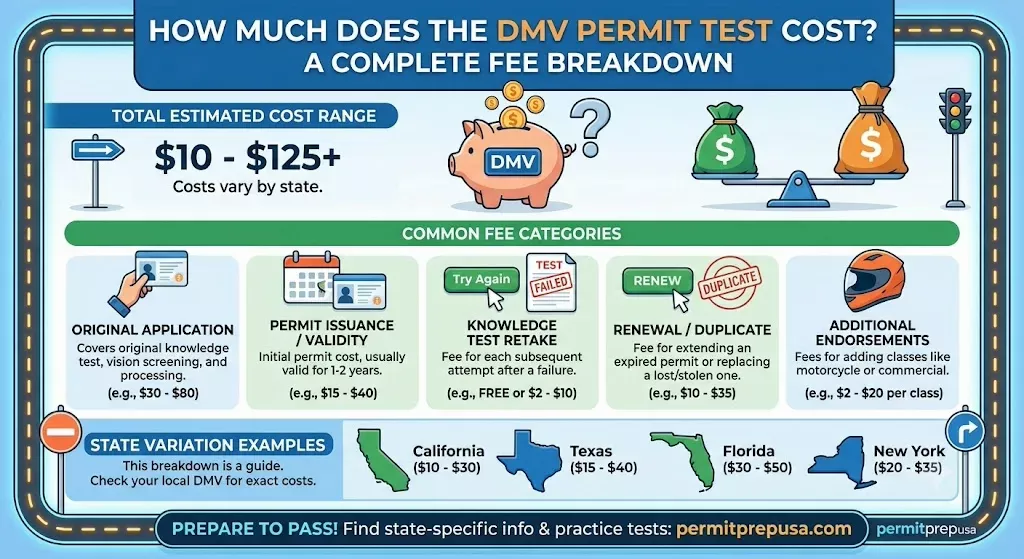
Quick-Answer Box: The cost of the DMV permit test varies significantly by state, generally ranging from a low of $10 to a high of $50. This initial payment is usually framed as an "Application Fee," which covers the administrative processing, your vision screening, the physical permit card, and typically up to three attempts at the written knowledge test. However, if you fail the exam, many states charge an additional $5 to $10 retesting fee for every subsequent attempt.
Every day, I watch applicants meticulously organize their paperwork, pass their vision screenings, and get ready to take their written knowledge exam. But right before I unlock the testing kiosk, I ask for the state application fee. That is when the scrambling begins.
A surprising number of first-time drivers and parents assume that because the DMV is a government agency, the permit test is a free public service. It is not. The Department of Motor Vehicles is a massive administrative machine, and every step of the licensing process carries a specific bureaucratic fee.
As a DMV examiner, I want you to walk up to my counter fully prepared—not just with the right documents, but with the right expectations for your wallet. Let's break down exactly what your application fee pays for, review the specific costs across major U.S. states, and uncover the hidden financial penalties of failing the exam.
What Exactly Does Your Initial Fee Cover?
When you hand over your debit card or cash at the DMV counter, you are usually not just buying a single test ticket. Most states bundle the knowledge exam into a comprehensive "Learner's Permit Application Fee." Understanding what is included in this package is crucial.
In the vast majority of jurisdictions, your initial payment covers four distinct administrative steps:
- Document Processing & Verification: The fee pays for the clerical time it takes an examiner to verify your identity, check your legal presence, and establish your driver profile in the state database. This is why knowing what to bring to your DMV permit test appointment is so critical; if you lack the right documents, you cannot even start the fee process.
- The Vision Screening: Before you take the written exam, you must pass a mandatory eye test at the counter.
- The Written Knowledge Exam (Usually 3 Attempts): The fee grants you access to the computerized testing terminal. In most states, this initial payment covers up to three separate attempts to pass the test.
- The Physical Permit Card: If you pass the test, the fee covers the cost of printing and mailing your official, secure paper or plastic learner's permit.
It is vital to understand that this fee is non-refundable. If you pay the $40 application fee and subsequently fail your exam three times, the DMV does not give you your money back. The state keeps the fee for processing your application, regardless of the testing outcome.
State-by-State Permit Fee Breakdown (Mobile-Friendly Chart)
Because traffic laws and administrative budgets are set by state legislatures, there is no federal standard for permit pricing. The cost in New York is vastly different from the cost in Texas. Furthermore, some states charge different fees depending on the applicant's age or the duration of the permit's validity.
I have compiled a streamlined, maximum two-column reference chart detailing the baseline learner's permit application fees for several major U.S. jurisdictions. (Note: These are baseline state fees and are subject to minor legislative changes or local county processing surcharges).
| State Jurisdiction | Approximate Learner's Permit Fee |
|---|---|
| California | ~$45.00 Covers the application and up to 3 testing attempts. |
| Florida | $48.00 Original Class E learner's license fee. (Retests cost $10 each). |
| Texas | ~$16.00 (Under 18) / $33.00 (Adults) Fee varies strictly by age demographic. |
| New York | $60.00 to $90.00+ (Varies by Age/Location) NY fees are complex, combining test fees with licensing fees based on age. |
| Pennsylvania | ~$35.50 Covers the permit application and physical card. |
| Illinois | $20.00 (Under 18) / $30.00 (Adults) Standard instruction permit fees. |
| Georgia | $10.00 One of the lowest fees, but strict on retake penalties. |
The Hidden Costs: Retesting Penalties
This is where applicants bleed money. Many people assume they can just keep taking the test over and over again until they memorize the answers. The DMV penalizes this behavior heavily through retesting fees.
While your initial application might give you three "chances," many states mandate that you pay a smaller administrative penalty fee for every attempt after the first one. For example, if you live in Florida and fail your first try, you must pay a strict $10 re-examination fee before the examiner will unlock the terminal for your second attempt.
What happens if you burn through all of your allowed attempts? The financial penalty becomes absolute. As we detailed extensively in our examiner's guide on how many times can you fail the permit test, once you fail your third attempt, your entire application file is voided.
To try for a fourth time, you must start from scratch. If you live in California, this means handing over another $45. If you fail to study, you are not just wasting your time; you are effectively paying a massive "unpreparedness tax" directly to the state.
Third-Party Fees: The Cost of Convenience
In recent years, many states have outsourced components of the licensing process to authorized private companies. This adds an entirely new layer of potential costs that you must be aware of.
Online Testing Surcharges
If you are exploring can you take the DMV permit test online, be prepared for convenience fees. In states like Florida, minors can take the exam from their home computer through an authorized third-party provider. However, these private companies charge their own proctoring fees (usually ranging from $15 to $30). You must pay this private fee to take the test online, and then you still have to pay the official state fee when you go to the DMV to print your physical card.
Mandatory Driver's Education
In states like Texas and California, teenagers cannot simply walk into the DMV, pay $45, and take the test. The state legally mandates that minors must enroll in a certified Driver's Education course first. These courses (whether taken online or in a physical classroom) are run by private businesses and can cost anywhere from $50 to over $400. You cannot escape this cost if you want a permit before you turn 18.
How to Pay at the DMV Counter
Another frequent disaster I witness is an applicant arriving with the exact correct fee amount, but in the wrong payment format. Not every DMV accepts every form of payment, and the rules can even vary from branch to branch within the same state.
- Cash: Almost universally accepted, but you should bring exact change.
- Credit and Debit Cards: Most modern offices accept Visa, MasterCard, and Discover. However, the state government will almost always pass the credit card processing surcharge (usually around 2% to 3%) onto you.
- Personal Checks or Money Orders: Generally accepted, but they must be made out precisely to the state's Department of Motor Vehicles.
If you arrive with only a credit card and the branch's network happens to be down that day, I cannot process your application. You will have to leave, find an ATM, and hope your appointment slot isn't given away. Always bring a backup payment method.
An Examiner's Advice on Protecting Your Investment
Getting a learner's permit is an investment. Between the application fee, potential third-party online proctoring, and mandatory driver's education courses, you might be spending over $100 before you even sit behind the wheel of a car.
The easiest way to double that cost is to fail the knowledge exam. When you understand the administrative fallout—which we mapped out in our guide explaining what happens if you fail the DMV permit test—you realize that a lack of study translates directly to lost money.
Treat this test with the financial respect it deserves. Do not try to guess your way through questions about blood alcohol limits or intersection right-of-ways. Study the official manual, understand the exact rules surrounding can you retake the DMV permit test if you fail, and utilize high-quality practice simulators. If you respect the preparation process, you will only have to open your wallet at my counter once.
