The Examiner’s Direct Answer: Can You Skip the Book?
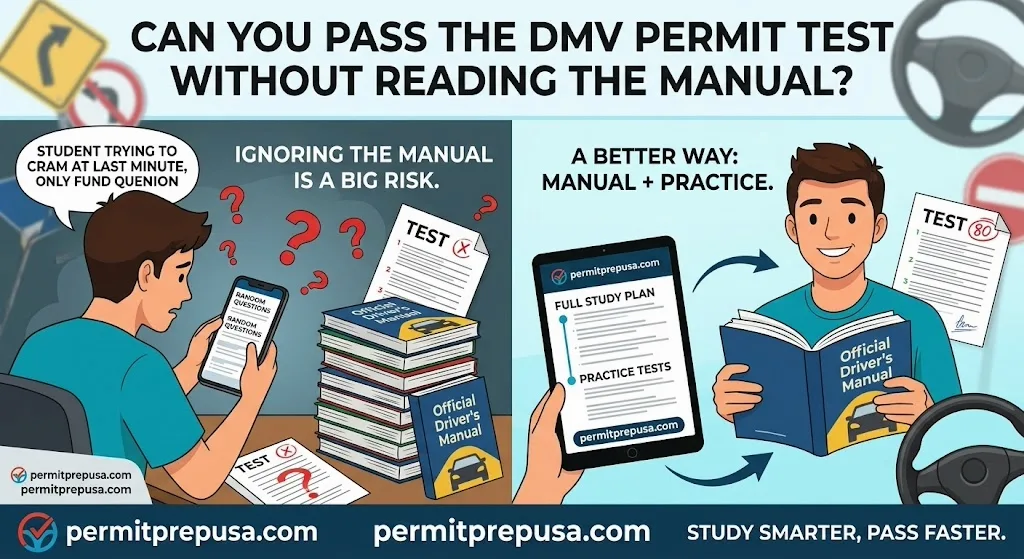
Quick-Answer Box: Technically, yes, a very small percentage of people get lucky and pass without reading the manual. However, as a DMV examiner, I can tell you that relying on luck is a terrible strategy. Over 90% of applicants who skip the official state handbook and rely solely on common sense or free internet quizzes end up failing. The exam tests highly specific statutory laws, fine amounts, and numerical distances (like BAC limits and feet required for signaling) that are impossible to guess without reading the source material.
I see it at my testing counter every single day. An applicant walks up, brimming with confidence, ready to take their written knowledge exam. When they inevitably fail and I ask how they prepared, the response is almost a cliché at this point: "I didn't read the manual, I just took a bunch of practice tests on my phone."
There is a dangerous rumor circulating among teen drivers and adults alike that the state driver's handbook is an optional piece of reading material. People assume that because they have been a passenger in a car their entire lives, they already understand the mechanics of traffic. They believe the test is merely a formality designed to check for basic pulse and common sense.
Let me be perfectly clear: the DMV does not test your general driving vibes. We test your specific, technical comprehension of state traffic law. The driver's manual is not a textbook of suggestions; it is the absolute legal source code from which every single question on your test is derived. If you want to know if you can pass without reading it, the short answer is that you are practically begging for an automatic failure lock-out.
The "Common Sense" Trap That Causes Instant Failure
The primary reason applicants attempt to bypass the handbook is arrogance. They assume driving is intuitive. To a certain extent, basic vehicle operation is intuitive—a red octagonal sign means stop, and a green light means go. But the written exam is not designed to test the obvious. It is designed to verify that you understand the complex legal scenarios that cause accidents and fatalities.
When you rely on common sense, you fall into the trap of choosing the "safest sounding" answer. Our question developers know this, and they actively design the multiple-choice options to punish guessing. To truly grasp the depth of what you are facing, it is highly recommended to read our comprehensive breakdown on how hard is the DMV permit test.
Consider these standard scenarios that you cannot simply "guess" correctly without reading the manual:
- The Drunk Driving Metrics: Common sense says "don't drink and drive." But the computer terminal will ask you for the exact blood alcohol concentration (BAC) percentage that dictates a DUI for a minor versus an adult, and the exact number of days your license will be suspended for refusing a breathalyzer under Implied Consent laws.
- The Distance Regulations: How many feet before a turn must you activate your turn signal in a residential neighborhood versus on an interstate highway? How many inches away from a curb are you legally required to park? These are rigid numbers, not general estimates.
- The Intersection Hierarchy: If three vehicles arrive at an uncontrolled intersection at slightly different times, who exactly has the right-of-way? Right-of-way laws are strictly defined statutory protocols, and failing to understand them is the number one reason people fail the exam.
The Danger of Relying Exclusively on Practice Tests
Many applicants believe they have found a shortcut: instead of reading a 100-page government document, they just download a free app and run through multiple-choice questions until they memorize the answers. While simulation is an important part of your preparation, using it as a replacement for the manual is a massive mistake.
When you only take practice tests, you suffer from the "Illusion of Competence." You are not actually learning traffic law; you are simply memorizing a specific sequence of words. If the DMV testing terminal phrases a question slightly differently than your app did, or if it asks for the exception to a rule rather than the rule itself, your memorization completely shatters.
Furthermore, third-party apps frequently use outdated or generalized national question pools. Traffic laws vary wildly from state to state. If you want to integrate simulations correctly, you must pair them with the official text. You can read our examiner's blueprint on the best DMV practice test strategy to see exactly how to balance these two study methods.
The Data Breakdown: Reading vs. Guessing
To put this into perspective, let's look at how preparation methods correlate directly to passing rates. I have organized this data into a streamlined, mobile-friendly two-column chart so you can easily weigh your options before deciding to skip the handbook.
| Preparation Method | Expected Examiner Outcome & Risk Level |
|---|---|
| Method A: Common Sense Only Skipping all reading and practice. |
Critical Risk (90%+ Failure Rate) Guaranteed failure due to specific numerical and legal questions. |
| Method B: Practice Apps Only Memorizing third-party questions. |
High Risk (50% Failure Rate) Likely to fail if the official DMV kiosk phrases questions differently. |
| Method C: Manual + Simulators Reading the book and testing recall. |
Maximum Safety (95% Pass Rate) Builds a deep knowledge buffer to easily clear the state's required score. |
Why the Manual Matters for Your Specific State
We operate under a decentralized licensing system in the United States. There is no single "national" permit test. Every state legislature writes its own traffic codes, which means the DMV in California evaluates drivers differently than the DMV in Florida or Texas.
If you don't read your state's specific manual, you are highly vulnerable to jurisdictional quirks. For instance, New York enforces incredibly strict sectional grading parameters regarding road signs. You might understand what is the DMV permit test fundamentally, but if you don't read the manual's specific rules on New York road signs, you will trigger an automatic failure clause regardless of your overall score.
The manual is the only document that is legally guaranteed to be accurate for your specific jurisdiction. If a law changed six months ago regarding cell phone usage in school zones, that change will be reflected in the state's official PDF, but it might not be updated on a random website's practice quiz.
How to Read the Manual Without Falling Asleep
I understand why people avoid the handbook. It is a dry, bureaucratic government document written by lawyers and administrators. It is not entertaining. But you do not need to read it like a novel. You need to read it like a technical blueprint.
When I advise applicants on how long should you study before taking the permit test, I emphasize that you only need to dedicate about 30 minutes a day to reading. You do not need to memorize the entire book. You need to hunt for the specific data points that our computers are programmed to extract:
- Skip the Fluff: You can generally skim over the introductory chapters about office hours, organ donation registration, and how to physically buy a car. The computer is not going to test you on the DMV's customer service mission statement.
- Highlight the Metrics: Grab a highlighter and aggressively mark any sentence that contains a number, a distance, a speed limit, a fine amount, or a time frame (e.g., "You must notify the DMV within 10 days of moving").
- Focus on the Visuals: Pay extreme attention to the pavement marking diagrams and the road sign charts. You must be able to differentiate between a solid yellow line, a broken yellow line, and a double solid white line instantly.
The Ultimate Truth from the Examiner's Desk
At the end of the day, you have a choice. You can try to cheat the system, skip the manual, and rely on luck. But when you do that, you are gambling with your time and your money. When you fail, you will have to step out of line, pay an additional retesting fee, and suffer through a mandatory state waiting period before you are legally allowed to try again.
Alternatively, you can respect the process. Understand that operating a vehicle is an immense legal responsibility. The driver's manual is given to you for free, directly by the agency that will be testing you. Read the material, pair it with high-quality simulated DMV practice tests, and you will walk up to my counter with absolute certainty that you are leaving with your learner's permit.
