The Examiner’s Direct Answer: What Is the Target Number?
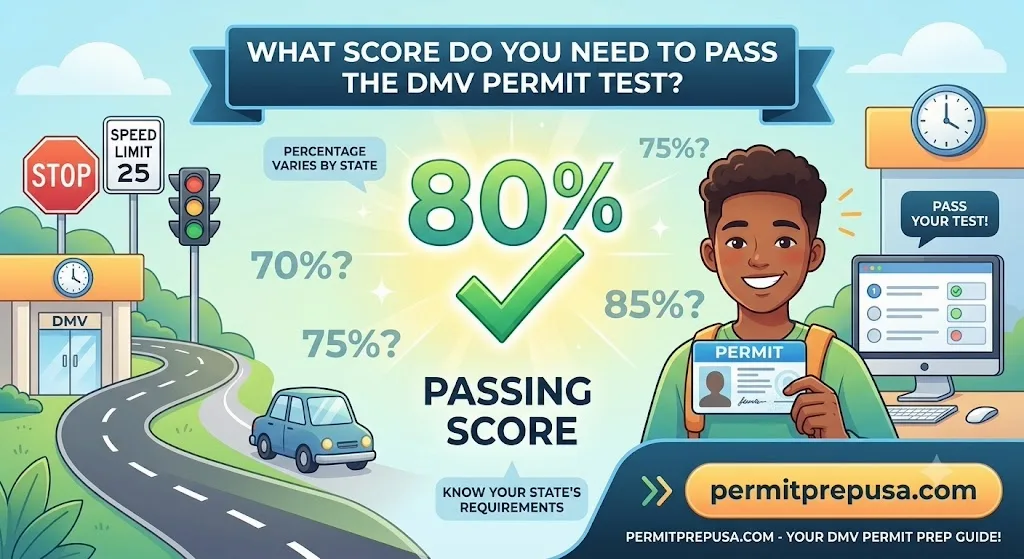
Quick-Answer Box: On a national average, you need a score of 80% to pass the written DMV permit test. However, passing scores are determined by individual states, meaning the requirement ranges from a lenient 70% (in states like New York and Texas) up to a strict 85% (in states like Maryland or Virginia). To find your exact passing threshold, you must cross-reference your state's required percentage with the total number of questions on the exam.
If there is one universal truth I have learned from my time behind the DMV counter, it is that applicants love to negotiate. People walk up to my terminal after failing their written exam by a single question and ask if I can "round up" their grade or give them partial credit because they were "so close." I have to look them in the eye and explain that traffic safety does not operate on a curve.
When you are dealing with state licensing regulations, you are dealing with absolute mathematics. There is a rigid threshold separating those who walk out with a valid learner's permit and those who are handed a failure notice. Before you even schedule your appointment, it is critical to understand not just what is the DMV permit test, but exactly what numerical benchmark you are expected to hit to satisfy the state's legal requirements.
Let's lift the hood on the DMV's automated grading system, map out the precise passing scores required across different regions of the country, and discuss why aiming for the bare minimum percentage is a dangerous preparation strategy.
How Your Final Score is Calculated at the Kiosk
Modern DMV knowledge exams are entirely digitized. When you sit down at one of our touch-screen or mouse-operated testing kiosks, the computer utilizes a real-time tracking algorithm to calculate your score as you progress through the question bank.
Every time you select an answer and hit submit, the system registers a binary result: either a 1 (correct) or a 0 (incorrect). The grading software is completely blind to context. It does not matter if you chose an answer that was "almost right" or if you accidentally clicked the wrong button due to nerves.
Because the test is graded live, you must understand how the raw score interacts with the state's percentage threshold:
- The Early Pass Trigger: If you are taking a 50-question test with an 80% passing requirement, your target number is 40 correct answers. The exact moment you record your 40th correct response, the computer will instantly terminate the test and display a congratulatory passing screen. It will not force you to answer the remaining 10 questions, because your passing score is already mathematically guaranteed.
- The Mathematical Cut-Off: Conversely, the computer constantly evaluates whether a passing grade is still possible. If your state allows a maximum of 10 mistakes, the very second you submit your 11th incorrect answer, the screen will turn red and lock you out. There is no reason for the system to show you the rest of the test because a passing score has become mathematically impossible.
This dynamic grading environment is a major reason why applicants frequently ask how hard is the DMV permit test. The pressure of watching your correct and incorrect counters adjust in real-time can be incredibly stressful for unprepared drivers.
The National Passing Score Reference Chart
Because motor vehicle laws are not standardized at the federal level, every single state has the authority to dictate its own testing difficulty. Some states believe a 70% (a C- grade in traditional academic terms) is sufficient to demonstrate baseline road safety. Other states demand a much higher standard, pushing the requirement into the B- or B range.
To help you visualize the specific benchmarks, I have organized the passing percentages and raw score requirements into a mobile-friendly breakdown of major U.S. jurisdictions. If you are curious about the total volume of these exams, you can review our guide on how many questions are on the DMV permit test for deeper context.
| State Jurisdiction | Passing Percentage & Raw Score Needed |
|---|---|
| New York | 70% Required Must answer 14 out of 20 correctly. |
| Texas | 70% Required Must answer 21 out of 30 correctly. |
| Georgia | 75% Required (Per Section) Must answer 15/20 on Rules & 15/20 on Signs. |
| Florida | 80% Required Must answer 40 out of 50 correctly. |
| Illinois | 80% Required Must answer 28 out of 35 correctly. |
| California (Under 18) | 82.6% Required Must answer 38 out of 46 correctly. |
| Pennsylvania | 83.3% Required Must answer 15 out of 18 correctly. |
| Maryland | 85% Required Must answer 21 out of 25 correctly. |
Why Sectional Requirements Override Your Total Score
When reviewing the chart above, you might think a 70% passing score in a state like New York makes the test incredibly easy. As a DMV examiner, I must warn you about the hidden sectional requirements that can instantly override your overall passing percentage.
Many state departments segregate their exams into two distinct categories: Rules of the Road (speed limits, right-of-way, DUI laws) and Road Signs (warning, regulatory, and guide signs).
In states with sectional scoring parameters, your total combined percentage is largely irrelevant. If a state requires a 75% on both the sign section and the rules section independently, you must hit that exact benchmark in both categories. If you achieve a perfect 100% on the road rules but only score a 70% on the road signs, your average score might look like a solid 85%—but you will fail the exam because a specific section fell below the legal threshold.
This strict structural mandate is one of the main reasons we see such high failure rates. If you want to dive deeper into the specific margins and allowances, review our detailed examiner's report on how many questions can you miss on the permit test.
The Difference Between Teen and Adult Passing Scores
Another critical variable in the scoring formula is the applicant's age. Several states—most notably California—utilize a tiered testing system based on your date of birth.
If you are a minor applying for a provisional learner's permit, the state typically views you as a higher-risk demographic with zero driving experience. Consequently, states will often mandate a longer, more comprehensive exam for teenagers to thoroughly vet their knowledge base. In California, teenagers face a 46-question test and must answer 38 correctly.
However, if you are 18 or older, you are applying for a standard instruction permit or an initial adult license. Many DMVs offer a condensed version of the knowledge exam for legal adults. Using the California example again, the adult test drops down to just 36 questions, though the passing percentage remains mathematically similar (requiring 30 correct answers).
Always verify with your local DMV branch which specific test variation you will be taking based on your age demographic, as this directly alters the raw score you need to memorize.
Why You Should Never Aim for the Minimum Requirement
One of the worst strategies you can adopt is studying just enough to hit the 80% mark. We see it all the time: an applicant consistently scores an 81% or 82% on random internet quizzes, assumes they are ready, and confidently schedules their DMV appointment.
What they fail to account for is the "Anxiety Tax." When you are sitting in your living room, the environment is relaxed. When you step up to an official government terminal with a time limit ticking down on the screen and other applicants waiting in line behind you, cognitive performance naturally drops. Nerves will almost always cost you two or three questions.
If your baseline knowledge is only at an 80%, that anxiety drop will push your score down into the 70s, resulting in an automatic failure, a retesting fee, and a mandatory waiting period.
An Examiner's Final Advice on Securing a Passing Grade
If you want to ensure you print out a learner's permit rather than a failure receipt, you must treat your preparation process as an exercise in over-compliance. Do not treat the driver's manual as optional reading. It is the direct source code for every single question on the exam.
When you transition from reading the manual to active simulation, you need to understand the stark difference between a DMV practice test vs real permit test. The objective of taking practice tests is not to barely cross the finish line; it is to build a massive safety buffer.
If your state requires an 80% to pass, your personal target during your study sessions should be a consistent 95% or higher. Build such a dominant understanding of stopping distances, road markings, and blood alcohol limits that even if you panic and make two or three careless mistakes at our kiosks, your score will still easily sail past the required legal threshold.
