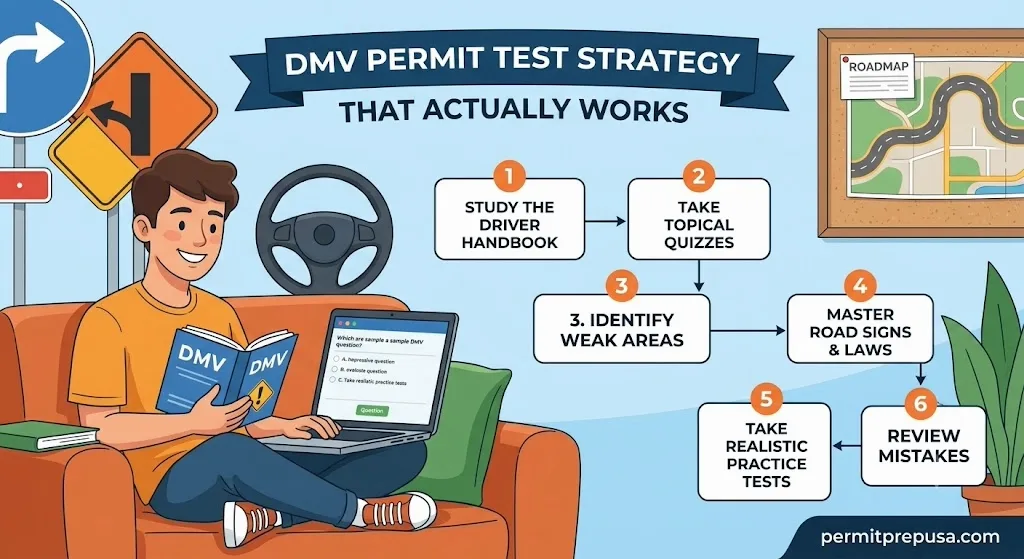
The Examiner’s Direct Answer: Why Your Practice Method Is Failing You
Quick-Answer Box: The best DMV practice test strategy is the **80/20 Rule Analysis**. Do not just take quizzes to see your score; instead, take a full-length, state-specific simulation, immediately extract the **20% of topics** you missed (such as specific right-of-way laws or fines), and study those exact chapters in your official manual. Repeat this cycle until you are consistently hitting a **95% passing average** across multiple unique question pools to account for real-time exam anxiety.
Every single day, I watch applicants stand in our lobby staring at failure receipts, completely bewildered. A phrase I hear constantly is: "But Examiner, I don't understand! I took dozens of free practice tests online and passed every single one of them at home."
When I dig a little deeper into how they actually used those tests, the flaw in their strategy becomes immediately obvious. They were treating practice tests like a game of memory matching. They took the exact same short quiz over and over again until they memorized the sequence of answers, rather than learning the actual underlying traffic laws. They mistook familiarity for true mastery.
As a DMV examiner, let me give you some straight talk: an online mock exam is a highly precision-engineered diagnostic tool, but it only works if you use it correctly. If you use a broken preparation strategy, you are simply setting yourself up for an automatic lockout at our terminals. Let's deconstruct the ultimate, examiner-approved practice test blueprint that will bulletproof your score margin.
The Core Flaw of Casual Testing: The Illusion of Competence
Most applicants approach practice testing with zero structure. They download a random app or click on the first free simulator they find via a search engine, run through 10 or 15 casual questions while sitting on the couch with the TV on, and scrape by with an 80%. They see the green passing screen and assume they have conquered the material.
This creates a dangerous cognitive bias known as the illusion of competence. In a relaxed home environment, your brain naturally filters out pressure. Furthermore, casual apps often use small question pools, meaning you see the exact same scenarios repeatedly.
When you step into our official testing facility, the entire environment shifts. Our automated grading networks draw randomly from massive databases containing hundreds of unique questions. If you have only memorized a tiny subset of answers from a basic online app, our terminal will instantly expose your knowledge gaps. To understand the baseline difficulty of our grading pools, make sure you review our comprehensive breakdown on how hard is the DMV permit test before scheduling your visit.
The 4-Step Strategic Blueprint for Maximum Score Retention
To turn mock exams into a bulletproof shield for your score buffer, you must abandon passive guessing and implement a rigorous, structured testing cycle. This is the exact strategy I recommend to applicants who come back to retake their exams after an initial failure.
Step 1: Replicate the Testing Environment Exactly
If you take a practice test with your state handbook open next to you, you are wasting your time. When you are ready to take a diagnostic exam, clear your desk, turn off your phone, and close all other browser tabs. Replicate the strict conditions of our office. If your state uses a time limit, set a timer. This forces your brain to manage cognitive stress and train its focus.
Step 2: Execute the 80/20 Error Extraction Method
The real value of a practice test isn't the questions you get right; it is the questions you get completely wrong. When a simulator flags an incorrect choice, do not just read the quick explanation snippet and hit "next." Stop immediately. Write down the core concept of that question on a notepad.
If you missed a question about blood alcohol concentration penalties, you have just diagnosed a critical weakness in your understanding of administrative law. This targeted approach is vital because you need to protect every point of your allowed buffer. For an exact analysis of your localized safety margins, read our examiner's guide on how many questions can you miss on the permit test.
Step 3: Source Reference the Official Handbook
Take your notepad of errors and open your state's driver manual. Find the specific chapter that covers your missed concepts and read the entire section cover-to-cover. If you missed a parking question, read the entire parking chapter. This repairs the structural foundation of your knowledge, ensuring that even if our terminal phrases the question differently, you will still know the core legal rule.
Step 4: Rotate Question Pools to Avoid Memory Burn
Never take the exact same practice test twice in a row. Switch between different sets of questions, full-length simulations, and sign-specific sub-quizzes. This ensures you are constantly testing your actual recall of traffic laws rather than simply recognizing the layout of an online page.
Pacing Your Strategy: A Mobile-Optimized Training Table
To build genuine testing stamina, you must scale your preparation over time. You cannot build the necessary mental focus for a comprehensive state exam in a single afternoon. To make this strategy scannable while you prepare your study routine, I have organized a highly effective testing progression into a clean, maximum two-column training matrix.
| Preparation Phase | Simulator Protocol & Metrics |
|---|---|
| Phase 1: Initial Baseline (Days 1 - 3) |
Untimed Topical Quizzes: Take short quizzes focused strictly on single chapters (e.g., Road Signs) to test foundational reading. |
| Phase 2: Error Hunting (Days 4 - 7) |
Full-Length Diagnostic Tests: Take 3 complete tests. Extract every incorrect answer and source-link it back to the handbook. |
| Phase 3: Stamina Building (Days 8 - 11) |
Timed Hard-Mode Simulation: Run simulations with a compressed timer. Aim to finish with a consistent 90% average. |
| Phase 4: The Anxiety Buffer (Days 12 - 14) |
Zero-Note Comprehensive Review: Achieve a 95%+ score across 5 consecutive unique exams to completely secure your permit. |
The Real-Time Kiosk Reality: Practice vs. The DMV Terminal
Many applicants fail to realize that our digitized testing infrastructure operates on an automatic termination algorithm. Unlike high school exams where you can review your paper before handing it in, our terminals grade your inputs live.
The structural layout of your state's exam dictates your margin for error. If you are preparing for a short, high-precision exam or a longer comprehensive test, your preparation metrics must adapt. For a deep dive into how our computer kiosks calculate passing margins live, review our critical study on what score do you need to pass the DMV permit test.
Your goal with online simulators is to ensure that you never trigger our automated failure algorithms. If you consistently hit a 95% at home, you leave yourself a massive buffer for environmental anxiety. Even if you panic and make three or four careless clicks at our counter, your score will easily clear the legal passing standard.
An Examiner's Final Check before You Book an Appointment
Before you log onto our scheduling portal and reserve a time slot at your local branch, you must pass your own internal audit. Do not use our office as a guinea pig to see if you are ready. Treat your initial preparation as a serious administrative process. Get a firm grasp on the overall testing landscape by reading our beginner's roadmap on what is the DMV permit test.
Once you understand the general framework, implement the 80/20 testing strategy relentlessly. Do not stop studying until your practice exam dashboards are completely green. If you respect the technical nature of our evaluation, study the data points, and verify your scores using rigorous simulation, you will walk up to my counter with absolute confidence and leave with your learner's permit on your very first try.
