The Examiner’s Direct Answer: What Is Your Safety Margin?
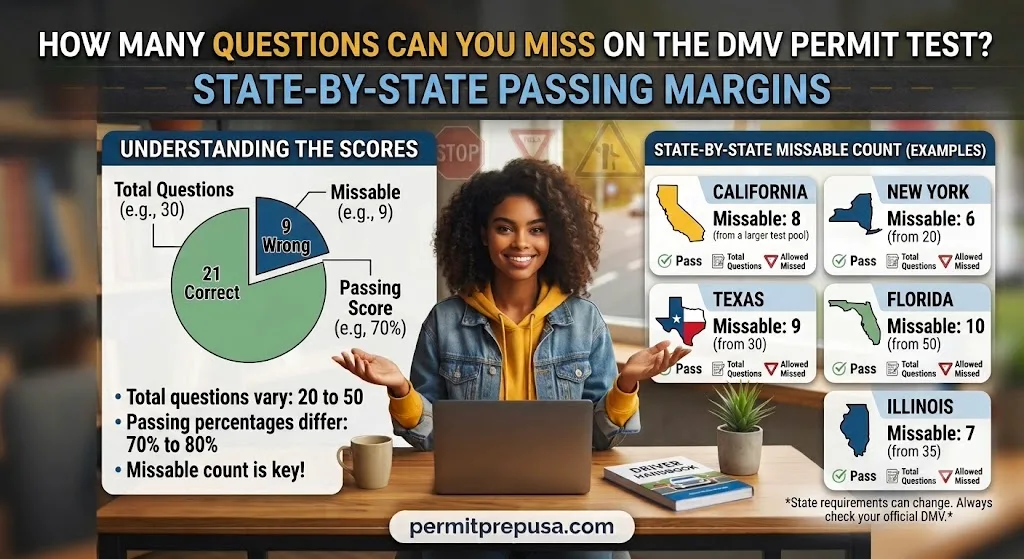
Quick-Answer Box: Across the United States, the written DMV permit test allows you to miss an average of 6 to 10 questions. Most jurisdictions enforce a strict passing threshold of 80%. This means on a standard 50-question exam (like Florida), you must answer 40 correctly, allowing 10 mistakes. On a shorter 20-question exam (like New York), you are only permitted 6 mistakes total—but a hidden trap dictates that missing more than 2 questions specifically on road signs results in an automatic, immediate failure regardless of your overall score.
Every single day, I watch applicants sit down at our DMV testing terminals, and I can almost see the mental math happening in their heads. Before they even read the first question on the screen, they are calculating their safety margin. They want to know exactly how many times they can click the wrong answer before the terminal locks them out, turns red, and prints out a failure notice.
As a DMV examiner, let me give you some straight talk: looking at this exam as a game of "how many can I get wrong" is usually the first step toward failing it. However, understanding your specific state's grading parameters is a highly effective way to manage test anxiety. When you know exactly how much room you have for error, you won't panic when you encounter a strangely worded question about blood alcohol concentration (BAC) or parallel parking distances.
To fully grasp the structure before diving into the numbers, it helps to understand the fundamentals of what is the DMV permit test from an administrative standpoint. Let's pull back the curtain on how we grade your exam, look at the precise state-by-state breakdowns using a clean, mobile-optimized format, and examine the critical scoring traps that catch unprepared applicants by surprise.
The Scoring Architecture: How DMV Terminals Evaluate Your Answers
Modern DMV knowledge tests do not operate like high school quizzes. We do not grade on a curve, we do not offer partial credit, and our automated testing systems evaluate your inputs in real-time. Every response you submit is a binary pass/fail data point. Across the country, state motor vehicle departments set their passing benchmarks between 70% and 85%, with 80% being the definitive national standard. Applicants frequently ask me how hard is the DMV permit test, and my answer is always the same: it depends entirely on how well you understand the grading mechanics of your specific jurisdiction.
The length of your state's test drastically alters how heavily an individual mistake impacts your final score. Understanding this math is vital for your preparation strategy:
- Short-Format Testing (15 to 25 Questions): Do not let a short test fool you into thinking it is easy. Shorter exams give you an incredibly narrow margin for error. On an 18 or 20-question test, every single mistake wipes out a massive chunk of your total grade. Missing just four questions can push you completely out of the running. These tests require absolute precision because your buffer is virtually non-existent.
- Long-Format Testing (40 to 50 Questions): While a longer exam demands more mental stamina and covers a far wider spectrum of the driver's handbook, it actually provides a much more forgiving cushion. If you experience a momentary lapse in concentration early in the test due to nerves, you have dozens of subsequent questions available to salvage your passing percentage and rebuild your momentum. To check the baseline ratios for your area, read our detailed analysis on what score do you need to pass the DMV permit test.
You must also realize that our testing terminals are programmed with termination logic. The moment you log your 40th correct answer on a 50-question test, the computer screen will immediately stop the exam, bypass the remaining questions, and inform you that you have passed. Conversely, the exact second you commit one more mistake than the legally allowed limit, the screen will terminate instantly. The system cuts you off because, mathematically, a passing grade is no longer attainable. You won't even get the chance to see the rest of the questions to practice.
The State-by-State Scoring Guide (Mobile-Friendly Layout)
Because traffic laws and driver licensing are regulated at the state level rather than federally, every state's Bureau of Motor Vehicles, Department of Transportation, or DMV establishes its own unique testing parameters. The total number of questions on the permit test varies wildly across borders. To make this data completely readable on your phone while you wait in line at our office, I have broken down the parameters into a streamlined, maximum two-column reference chart matching the jurisdiction to its maximum mistake allowance.
| State & Total Questions | Maximum Allowed Mistakes |
|---|---|
| California (Minors) 46 Questions Total |
8 Mistakes Allowed Requires 38 Correct (82.6%) |
| California (Adults 18+) 36 Questions Total |
6 Mistakes Allowed Requires 30 Correct (83.3%) |
| Florida 50 Questions Total |
10 Mistakes Allowed Requires 40 Correct (80%) |
| Texas 30 Questions Total |
9 Mistakes Allowed Requires 21 Correct (70%) |
| New York 20 Questions Total |
6 Mistakes Allowed Subject to Category Rules |
| Georgia 40 Questions Total |
5 Mistakes Per Section Split Rules & Signs Exam |
| Pennsylvania 18 Questions Total |
3 Mistakes Allowed Requires 15 Correct (83.3%) |
| Illinois 35 Questions Total |
7 Mistakes Allowed Requires 28 Correct (80%) |
Let's look closely at the operational specifics of these major states so you can understand how these metrics apply when you stand at the counter.
California Knowledge Test Parameters
The California DMV strictly categorizes applicants by age. If you are a minor under the age of 18 applying for a provisional learner's permit, you face a comprehensive 46-question test. You must achieve 38 correct answers, giving you a maximum allowance of 8 mistakes. If you are an adult aged 18 or older, your exam drops to 36 questions, requiring 30 correct answers and permitting exactly 6 mistakes. Take note: if you exceed your mistake allotment in California, the state imposes a mandatory one-week waiting period before you can attempt the test again.
Florida Class E Knowledge Exam Metrics
Florida utilizes a standard 50-question format covering road rules and road signs. This exam provides a 10-mistake margin, which sounds generous but covers a massive database of potential questions. Florida allows minors to take this exam online via certified third-party platforms, but our electronic tracking systems monitor for cheating and irregular timing patterns to maintain total test integrity.
Texas Driver's License Written Exam Layout
Texas keeps its written evaluation to a moderate 30 questions. The state also features one of the lower passing thresholds in the nation at 70%. You only need to answer 21 questions correctly, leaving you with a margin of 9 allowed mistakes. Do not let that lower percentage lower your guard; the Texas driver's handbook contains dense sections on state-specific traffic fines, open container laws, and minor-in-possession penalties that regularly penalize careless test-takers.
The Hidden Sectional Traps That Cause Instant Failure
This is where thousands of applicants fail every single week. They look at the raw percentages and assume that as long as their total number of correct answers matches the requirement, they will be handed a permit. That is completely false. Several prominent states use sectional grading parameters. If you fail one specific category, you fail the entire exam on the spot—even if your overall score is mathematically excellent.
The New York Road Sign Rule
New York has an incredibly short 20-question test. To pass, you need a 70%, which translates to 14 correct answers and allows for 6 mistakes. However, the New York DMV explicitly isolates 4 of those 20 questions to test regulatory and warning road signs exclusively.
By state law, you must answer at least 2 of those 4 road sign questions perfectly. Consider this scenario: an applicant answers all 16 road rules questions flawlessly but misses 3 out of the 4 road sign questions. Their total score is 17 out of 20, which is a fantastic 85%. However, because they exceeded the 2-mistake limit within the road sign category, the testing terminal terminates the session and registers an automatic failure. No exceptions.
The Georgia Two-Part Split Test
The Georgia Department of Driver Services (DDS) runs an even stricter divisional system. Their 40-question knowledge exam is severed cleanly down the middle into two independent phases: 20 questions covering Road Rules and 20 questions covering Road Signs.
You are required to score at least a 75% on each individual part. This means you can commit no more than 5 mistakes on the Road Rules section, and no more than 5 mistakes on the Road Signs section. If you achieve a perfect 20 out of 20 on your road signs but make 6 mistakes on your road rules, your combined score of 34 out of 40 (85%) means absolutely nothing. The system will fail you because you breached the individual margin limit of a single section.
Why Applicants Exceed Their Allowed Mistakes: Insider Observations
From my vantage point behind the DMV counter, I watch the testing room all day. I know exactly why people burn through their allowed mistakes within the first ten minutes of their attempt. It almost always boils down to three distinct, preventable behaviors:
1. Rushing Past Modifier Words
The automated test database is deliberately designed to verify that you are reading closely. It isn't trying to trick you, but it uses highly precise language. Applicants frequently fly through questions and completely miss words like "EXCEPT," "NOT," "ALWAYS," or "NEVER." Missing a single modifier word completely reverses the meaning of the question, causing you to select the exact opposite of the correct answer and burn a safety margin point entirely by accident.
2. Over-Relying on "Common Sense"
Many adults and teenagers assume that driving is entirely intuitive. They believe that if they use general logic, they can guess their way through the choices. This is a massive mistake. Common sense will not tell you the exact distance in feet you must maintain when following a school bus, nor will it tell you the precise number of days you have to notify the DMV of a change of address. When you hit the specialized technical data points in the handbook, unstudied "common sense" leads directly to a failed exam.
3. Misunderstanding Right-of-Way at Intersections
If there is one subject matter category that completely destroys an applicant's mistake buffer, it is intersection right-of-way rules. Questions involving four-way stops, uncontrolled intersections, and blind left turns have highly specific legal protocols. If you do not know exactly who yields to whom, the exam will quickly exploit that gap in your knowledge base.
What Happens Behind the Counter If Your Screen Turns Red?
If you make one too many mistakes and fail the exam, do not despair. It is an incredibly common occurrence, and we see it every single day. Your first step should be to walk calmly back up to the counter so we can process your paperwork and explain your next steps. The exact consequences of exceeding your mistake margin vary by state:
Mandatory Waiting Intervals: You cannot simply step into the back of the line and try again immediately. States impose cooling-off windows to force you to study. Some jurisdictions allow a retest after 24 hours, while others require you to wait a full 7 days (like California) or even 15 days before the computer terminal will unlock your applicant profile for a new attempt.
Retesting and Application Fees: Your initial DMV application fee typically covers your processing and your first one to three testing attempts. If you fail to pass within those initial attempts, your application file is legally closed. You will be required to pay a brand-new application fee to reset the system and grant yourself a fresh batch of testing opportunities.
An Examiner's Blueprint for Protecting Your Score Buffer
If you want to walk into our office and clear the test without ever worrying about your mistake count, you need to change how you prepare. Do not just read the driver's manual like a fiction novel; treat it like a technical blueprint.
To truly understand how to gauge your readiness, you need to evaluate how a simulated DMV practice test vs real permit test environment compares. When you utilize online testing simulators, do not stop practicing the moment you scrape by with a minimum passing score. If your state allows 8 mistakes, your target during preparation must be to consistently hit zero or one mistake on your practice exams.
You need to build a massive knowledge safety margin at home so that when real test anxiety hits you in our office, you have plenty of room to spare. Slow down, study the exact distances, fines, and road signs in your specific state handbook, and you will walk out of our facility with a valid learner's permit in your hand.
