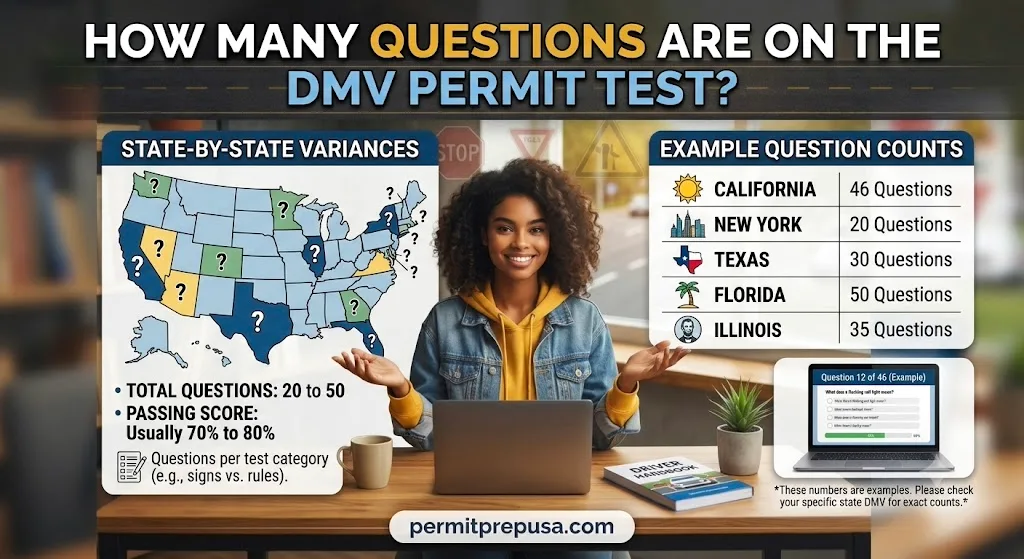
One of the first things people want to know before their permit test is simple: how many questions will actually be on it? The answer isn't the same everywhere, and understanding the range can help you set realistic expectations before your appointment.
How Many Questions Are on the DMV Permit Test?
Most DMV permit tests contain between 25 and 50 multiple-choice questions, though the exact number depends on your state.
There's no single national standard for the permit exam. Each state's DMV designs its own version of the test, pulling questions from its own driver handbook. Some states keep it relatively short at around 25 questions, while others use a longer format with 40 or 50 questions to cover more ground. Always check your state's DMV website for the exact number that applies to you.
Quick Reference: Typical Question Counts
| Test Length Type | Approximate Question Count |
|---|---|
| Shorter State Tests | 25–30 questions |
| Mid-Length State Tests | 30–40 questions |
| Longer State Tests | 40–50 questions |
Why Does the Number of Questions Vary by State?
Since each state writes its own permit test based on its own handbook, the length reflects how much material that state wants to cover in a single sitting. A state with more nuanced local traffic laws or additional road sign categories may include more questions to test that knowledge thoroughly. This is also why a practice test built for one state might not match the exact question count you'll see in another.
Does a Longer Test Mean It's Harder?
Not necessarily. A test with more questions isn't automatically more difficult — it may simply cover more topics at a similar difficulty level, rather than asking fewer, tougher questions. Difficulty tends to come down more to how well you understand the handbook material than to the total question count. If you're curious about difficulty specifically, our guide on how hard the DMV permit test really is covers that in more detail.
How Does Question Count Relate to Passing Score?
The number of questions directly affects how many you can afford to get wrong. For example, on a 25-question test with an 80% passing threshold, you can typically miss about 5 questions. On a 50-question test with the same threshold, you might be able to miss around 10. Since these numbers differ by state, it's worth knowing the exact math before you go in. Our guide on how many questions you can miss on the permit test breaks this down state by state.
Are All Questions Weighted Equally?
In most states, yes — each question typically counts the same toward your final score, regardless of topic. That said, some states place extra emphasis on certain categories, like right-of-way rules or road signs, simply by including more questions from those categories rather than assigning different point values.
What Topics Make Up Most of the Questions?
While the total count varies, the general breakdown of topics tends to stay fairly consistent across states. Most tests draw heavily from:
- Road signs and their meanings
- Right-of-way and intersection rules
- Speed limits and safe driving distances
- Traffic laws, including seatbelt and DUI rules
- Special situations like school buses and work zones
Since these categories repeat across nearly every state's test, focusing your studying here tends to pay off no matter where you're taking the exam.
Does the Question Count Affect Test Length?
Generally, yes. A test with more questions will naturally take longer to complete, though most permit exams are still designed to be finished within about 20 to 30 minutes. Time limits are usually generous enough that pacing isn't a major concern if you've studied the material.
How to Prepare When You Don't Know the Exact Count
If your state doesn't publish an exact question count, the safest approach is to prepare as if the test covers all major categories thoroughly, rather than trying to guess a specific number. Reading the handbook in full and practicing across a range of topics will prepare you regardless of whether your test has 25 questions or 50. For a full study approach, see our guide on how to study for the DMV permit test.
Bottom line: while the exact number of questions varies by state, studying the core topic areas thoroughly will prepare you regardless of whether your test has 25 questions or 50.
Want to get a feel for the real format? Try our free practice test and see how you do under similar conditions.
