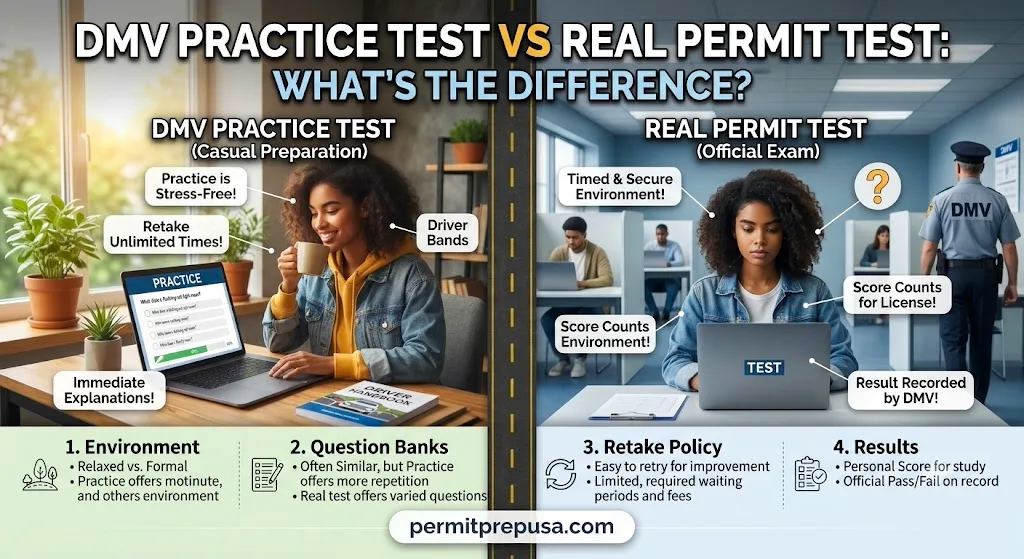
If you've started studying for your permit, you've probably come across dozens of "free DMV practice tests" online. They're everywhere, and they can genuinely help — but they are not the same thing as the real exam you'll take at the DMV. Understanding exactly how they differ will help you use them more effectively instead of relying on them as a substitute for real preparation.
What's the Difference Between a Practice Test and the Real Permit Test?
A DMV practice test is an unofficial study tool built by third-party websites to mimic the real exam, while the actual permit test is the official, state-administered exam that determines whether you receive your learner's permit.
Practice tests are created independently, usually by driving schools or educational websites, using sample questions modeled after your state's driver handbook. The real permit test, by contrast, is written and administered directly by your state's DMV (or equivalent agency) and is the only exam that actually counts toward getting your permit.
Quick Comparison
| Feature | Practice Test |
|---|---|
| Created By | Third-party websites or driving schools |
| Official Status | Unofficial study tool only |
| Counts Toward Permit | No |
| Question Source | Modeled after the state handbook |
| Retake Limit | Unlimited, no waiting period |
Who Writes the Questions?
This is one of the biggest points of confusion. Practice test questions are written by whoever runs the website or course — not by the DMV. That means the questions are inspired by real handbook content, but the exact wording, difficulty, and even the correct answer explanations can vary from site to site. The actual permit test questions are written internally by state DMV staff and pulled from an official question bank that isn't publicly shared in full.
Every state writes its own version of the permit test based on its driver handbook, so a practice test built for one state may not accurately reflect the exam in another. Always verify that the practice material you're using matches your specific state's rules through your state's DMV website.
Does Practice Test Difficulty Match the Real Test?
Not always. Some practice tests are noticeably easier than the real exam, which can create false confidence. Others are intentionally harder, designed to make sure you're over-prepared. Neither extreme perfectly mirrors the real thing, since only the DMV controls the actual question bank and difficulty curve. The safest approach is to treat practice tests as a way to identify weak spots, not as a predictor of your exact real-world score.
Are the Question Formats the Same?
Most practice tests use a multiple-choice format similar to the real exam, which is genuinely helpful for getting comfortable with how questions are phrased. However, some practice platforms include question styles — like true/false or fill-in-the-blank — that don't appear on the actual DMV exam. If a practice test looks very different in structure from what your state describes in its handbook or DMV website, treat it as a general study aid rather than an exact simulation.
Do Practice Tests Affect Your Real Score?
No. Practice test results have zero impact on your official permit test outcome. You can take as many practice attempts as you want, fail all of them, and still walk into the DMV with a clean slate. This is actually one of their biggest advantages — they let you make mistakes and learn from them with no real consequences, unlike the real exam, which usually comes with a waiting period if you fail. For more on what happens if that occurs, see our guide on what happens if you fail the DMV permit test.
How Many Practice Tests Should You Take?
There's no single magic number, but most people benefit from taking several practice tests across different sources rather than repeating the same one. This exposes you to a wider range of question styles and reduces the risk of accidentally memorizing answers instead of actually understanding the material. If you want a more detailed breakdown of how many attempts are typically recommended before test day, check our guide on how many practice tests you should take before the DMV exam.
Can You Pass the Real Test Using Only Practice Tests?
It's possible, but risky. Since practice tests are unofficial and don't cover every nuance in your state's handbook, relying on them exclusively can leave gaps in your knowledge — especially around state-specific laws that a generic practice test might not include. Combining handbook reading with practice testing is a far more reliable strategy. Our guide on DMV handbook vs practice test: which should you study first breaks down the ideal order to study both.
Are Free Practice Tests Good Enough?
Many free practice tests are genuinely well made and cover the core categories you'll need — road signs, right-of-way rules, and basic traffic laws. That said, quality varies a lot between websites, and some free tests are outdated or based on handbooks that haven't been updated in years. It's worth double-checking that any practice resource you use references current rules for your state. We go deeper into this topic in our guide on whether free DMV practice tests are good enough.
How to Use Practice Tests Effectively
Practice tests work best when used as a diagnostic tool rather than your only study method. A simple, effective approach looks like this:
- Read the relevant handbook chapter first
- Take a practice test on that same topic
- Review any missed questions and understand why the correct answer is right
- Repeat with a new topic or a different practice test source
This cycle reinforces the material instead of just testing memorization, and it mirrors the structure many successful test-takers use when preparing for the real exam.
Signs You're Ready for the Real Exam
You don't need a perfect practice test score to feel ready, but consistently scoring well across multiple different practice sources is a strong signal. If you're regularly getting 90% or higher on tests from more than one website, and you understand why each answer is correct (not just which letter to pick), you're likely in good shape for the real thing.
Bottom line: practice tests are a valuable tool for identifying weak spots, but they're not a replacement for reading your state's handbook or taking the real, official exam seriously.
Ready to put your knowledge to the test? Try our free practice questions to see how prepared you really are before your DMV appointment.
